Short answer
To evaluate technology in needle and sharps disposal, ask what specific problem it solves, what it cannot detect, how it fits a trained crew's search and a licensed disposal route, and what evidence backs its claims. Useful tools include proper grabbers and containers, good lighting, mapping and reporting apps, and public kiosks. No gadget replaces a careful, documented human search.
Why caution comes first
Sharps work has a simple core: find every needle you reasonably can, pick it up without getting stuck, contain it, and send it to proper treatment. Technology can make each of those steps faster or safer. It can also create false confidence if a tool is sold as doing more than it does.
The stakes are high in both directions. A good tool can cut injuries and help crews cover more ground. A tool that misses plastic syringes, or a report that looks precise but reflects a hurried search, can leave needles behind in a playground or parking lot.
The questions below apply whether you are a property owner comparing providers, a facilities manager buying equipment for trained staff or a city planning a public program.
It is also worth remembering that technology has a cost beyond its price tag. Equipment needs cleaning, charging, calibration and replacement, and staff need time to learn it. A tool that sits in a truck because nobody trusts it adds nothing. The best purchases tend to be the ones that fit the way trained people already work.
Five categories of sharps technology
Start by naming the problem. Most technology in this field falls into one of a few categories, and each has different limits.
Once you know the category, you can ask the right follow-up questions. A detection tool should be judged on what it misses. A handling tool should be judged on whether it keeps hands away from points. A reporting tool should be judged on whether the data it produces leads to better decisions.
- Detection: tools that help find needles, such as lighting, magnetic sweepers and metal detectors.
- Handling: tools that keep hands away from needle points, such as grabbers, tongs and puncture-resistant gloves.
- Containment: sharps containers, wall-mounted units and public kiosks.
- Destruction: devices that clip, melt or otherwise disable needles at the point of use.
- Information: apps, 311 systems and mapping tools that track where needles are reported and collected.
Do metal detectors and magnetic sweepers find every needle?
No. Needle cannulas are usually steel, so magnetic tools can pull some of them from gravel, grass or mulch. But syringe barrels, plungers and caps are plastic, and a needle that has broken off or been bent inside a barrel may not respond well. Detectors can also be overwhelmed by nails, bottle caps, foil and other metal debris.
Used well, these tools are a second pass. A crew searches visually in overlapping lanes, then runs a magnetic sweeper over gravel or dense turf to catch anything missed. Used badly, they become the whole search, and anything plastic stays behind.
If a provider mentions detection equipment, ask how it fits into their method and what they do for items the equipment cannot find.
Claims about camera systems or software that spot needles automatically deserve the same scrutiny. Ask what conditions the system was tested in, how often it misses items in grass or leaf litter, and whether a person still walks the area afterward. If the answer to the last question is no, keep looking.
Which handling tools make the biggest difference?
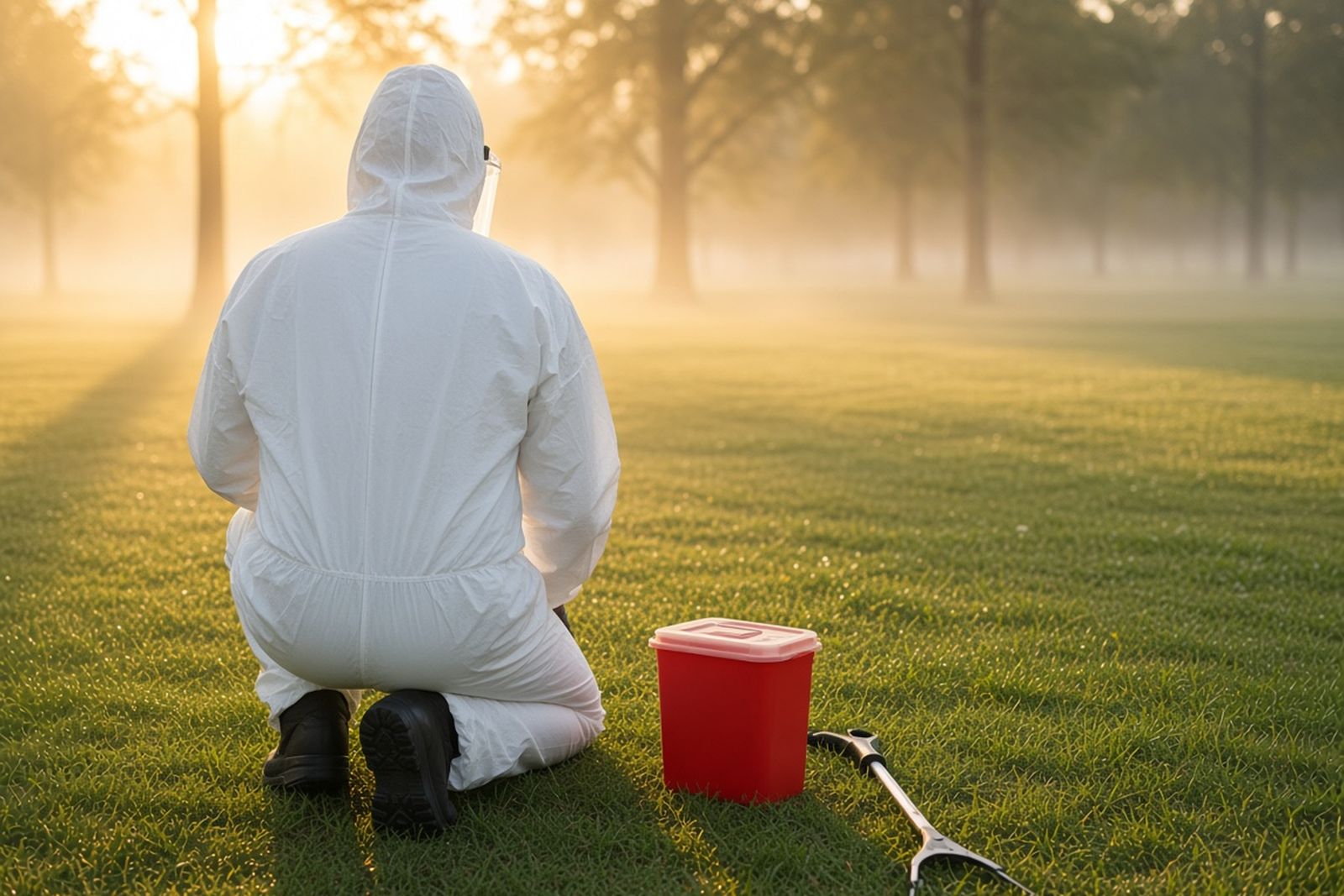
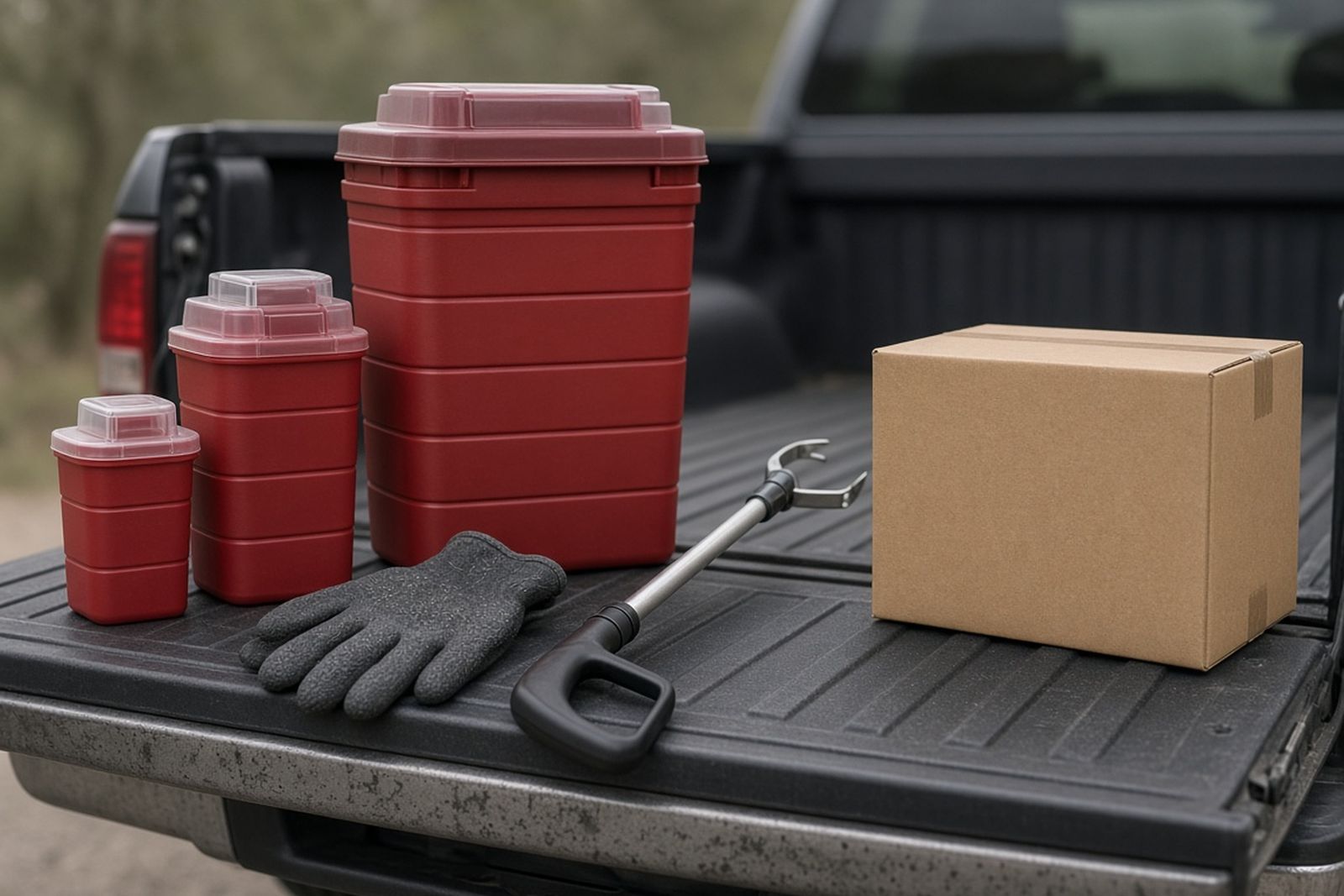
The most valuable technology in this field is often the least exciting. Long-handled grabbers with fine, firm jaws let a technician pick up a syringe from a flat surface or a crevice without bending close. Tongs designed for sharps can handle a needle by the barrel. Puncture-resistant gloves add a layer of protection, although no glove is fully needle-proof.
Containers are equally important. A field container should be rigid and puncture-resistant, stay upright, close securely and carry a clear hazard label. For field crews, containers that can be carried on a belt or held at the point of pickup reduce the distance a needle travels in a grabber, which reduces drops.
When evaluating handling tools, look for ones that let the technician keep both the needle point and their hands in view at all times. Tools that require awkward angles or two-handed transfers invite accidents.
Lighting, the underrated tool
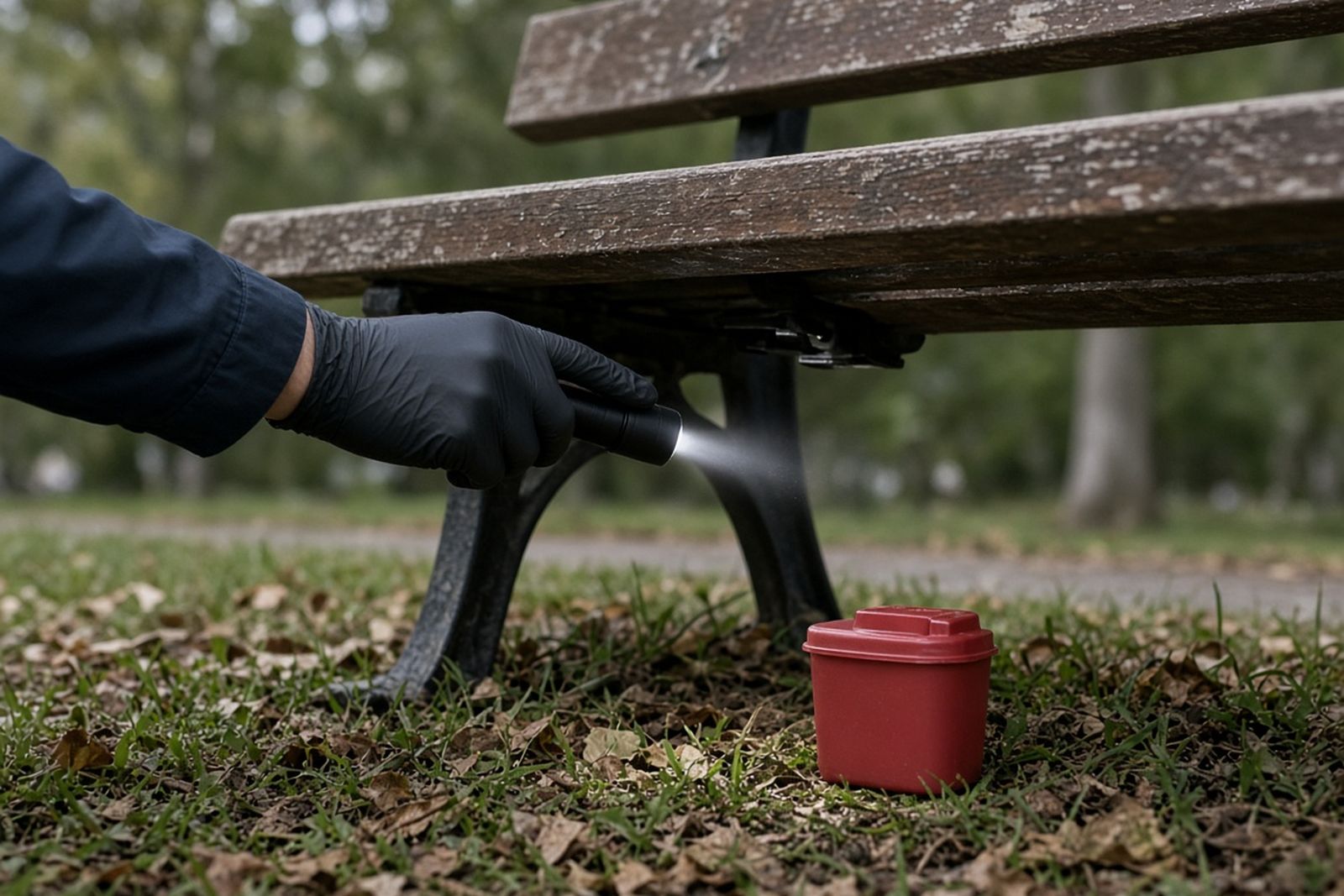
Lighting belongs alongside handling tools. Headlamps and portable work lights let technicians see into shrub bases, stairwell corners and the gaps behind dumpsters. A crew searching at dusk without proper light is working blind, however good its other tools are.
Mapping apps and 311 data
Reporting systems have changed how cities see this problem. When residents can report a needle through a phone app or a 311 line, the data builds a map of where needles show up and when. Researchers studying San Francisco reported in 2020 that discarded-needle reports to the city's 311 system rose from 221 in 2010 to 8,679 in 2019, with 34,912 reports analyzed over the decade.
That kind of data is powerful but needs careful reading. A rise in reports can reflect more needles, more awareness, easier reporting or all three. Neighborhoods where residents are less likely to use apps may be undercounted.
For a single property, simpler tools often work just as well. A shared log or a provider's report with a marked site map can reveal hot spots, such as a poorly lit stairwell or a gap in a fence, and guide fixes. Ask any provider who offers digital reporting whether you can export the data and keep it.
Smart kiosks and public disposal boxes
Public disposal boxes give people a safe place to drop sharps, and some newer units add features like fill-level sensors that alert the operator when a box needs emptying. The technology is secondary to placement and trust. A box in the wrong spot, or one that is often full, will not be used.
Research on public boxes suggests awareness does not guarantee use. In a 2021 study of a Philadelphia neighborhood, Roth and colleagues found that 78% of respondents had noticed a public syringe-disposal box, but among those noticing a box, 34.1% had used one. Placement, lighting, outreach and a reliable emptying schedule all shape whether a kiosk makes a difference.
If you are considering a kiosk on or near your property, ask who will service it, how often, where the contents go and whether the local health department or syringe services program has input on placement.
Needle clipping and destruction devices at home
Several devices are sold to people who inject at home. Some clip the needle off a syringe and store it inside a sealed chamber. Others use heat or electricity to melt or blunt the needle.
These can reduce the chance of injury from the needle portion and shrink the volume of sharps waste. They do not solve disposal on their own. The clipped needles, the device's chamber and the remaining syringes still need to go through an approved route, and local rules may treat them as sharps waste regardless.
Before buying one, check that it is intended for the type of needle you use, read the maker's instructions for emptying and disposal, and confirm with your local waste authority how the result should be handled.
Illustration: a university grounds team picks its tools
The university here is a made-up composite, used to show how the questions play out. Its grounds department starts finding syringes near a parking structure and in shrub beds along a campus edge. The director is offered a package that includes metal detectors, a mapping app and new signage, and wants to know which pieces are worth it.
The director starts with the basics. The team adopts a written exposure plan, trains two designated responders, and buys quality grabbers, puncture-resistant gloves and belt-mounted sharps containers. Those purchases directly reduce the chance of a stick.
The director then trials a magnetic sweeper on the gravel strip by the garage and finds it catches a few bent needles the visual search missed, so it stays as a second pass. The mapping app is replaced with a shared spreadsheet and photos, which the team finds faster to update. After six months of logs point to one poorly lit garage stairwell, the university adds lighting and a wall-mounted sharps container there. The director budgets for what the records showed was useful and drops the rest.
Six questions before trusting a new tool or claim
A little skepticism goes a long way. Technology that works will hold up to plain questions. Technology that relies on marketing tends to fall apart when you ask what it misses.
Above all, remember that the most important safeguards in sharps disposal are human: training, a methodical search, a no-touch rule for untrained people and a licensed disposal route. Technology should support those, not replace them.
- What specific step does this tool improve: finding, handling, containing, destroying or tracking?
- What will it miss, and how will those gaps be covered?
- Is there independent evidence or at least a documented trial on sites like mine?
- Does it change where the waste ends up, and is that route licensed?
- Who maintains it, and what happens when it fails?
- Will I own the data or reports it produces?