Short answer
The science of sharps disposal comes down to three facts. Hollow needles can hold a small amount of blood where viruses stay protected for days or weeks. Most injuries happen during handling, especially recapping and overfilled containers. And only rigid, puncture-resistant containers followed by heat or incineration treatment reliably break the chain from a used needle to the next person.
Sharp and hollow: why needles are their own category
Most medical waste is a contact hazard. A soiled bandage can only cause harm if it reaches broken skin or a mucous membrane. A needle is different because it creates its own entry point. It can pierce gloves, skin, and thin plastic bags in a fraction of a second, delivering whatever is on or inside it directly beneath the surface.
That combination of sharpness and delivery is why sharps get their own category, their own containers, and their own handling rules. Lancets, auto-injector pens, scalpel blades, and broken glass that touched blood fall under the same thinking. Anything that can cut or pierce and may carry blood is treated the same way.
Understanding that idea helps you see why rules that seem fussy, such as never pushing a needle into a full container, are not fussy at all. They exist because the object itself does the injuring.
The hollow bore adds a second layer of risk. Hypodermic needles are hollow tubes. After an injection, a tiny column of blood can remain in the bore of the needle and in the hub where it joins the syringe. Solid sharps such as suture needles or blades carry blood only on their outer surface, where it wipes off as the object passes through gloves or skin.
With a hollow needle, that inner reservoir is carried below the skin during an accidental stick. That is one reason injuries from hollow-bore needles are treated as higher risk than scratches from solid objects. Syringes with a larger dead space, the volume that stays filled after the plunger is fully depressed, can hold even more.
This is also why a discarded syringe with the plunger drawn back or a visible trace of blood in the barrel is not something to inspect up close. You do not need to know how much is inside. The safe assumption is always that some blood remains.
How long viruses survive, and what one stick really risks
Viruses vary widely in how well they tolerate the outside world. Hepatitis B is especially durable. The CDC states in its 2024 clinical overview that hepatitis B virus remains infectious on environmental surfaces for at least 7 days.
Inside a syringe, protection from drying and light can extend survival further. A 2010 Journal of Infectious Diseases study found viable hepatitis C virus in high-dead-space tuberculin syringes up to 63 days after contamination. Laboratory conditions are not the same as a syringe lying in a gutter, but the finding shows why age and appearance are poor guides to risk.
HIV, by contrast, is more fragile on open surfaces, though it can also survive for a time in protected blood. The real point for you is that there is no safe waiting period after which a found needle can be picked up by hand.
The risk from a single stick depends on the virus, the source, the depth of the injury, and the person who was stuck. For HIV, CDC's Stop Sticks program put the estimated risk from a single sharps injury involving an HIV-positive source at about 0.3 percent, or 1 in 300, in material archived in 2019. Hepatitis B and C carry higher per-injury risks, which is why hepatitis B vaccination is so strongly encouraged for anyone who handles sharps.
For a needle found in the community, the source is unknown. That uncertainty is what makes medical follow-up important even when the numbers are reassuring. A clinician can assess the injury, order baseline testing, and decide whether preventive treatment makes sense.
If you are stuck, let the wound bleed freely, wash it with soap and water, do not squeeze or scrub aggressively, and seek medical care promptly. Bring the needle only if it can be moved safely in a rigid container; never go back to pick it up by hand.
Most injuries happen during handling, not use
The moment of highest danger is often after the needle has done its job. Recapping is a classic example. Guiding a thin needle back into a small cap requires bringing the point toward your own hand, and a slight misjudgment sends it into a finger.
Overfilled containers are another. When a container is stuffed beyond its fill line, the next sharp dropped in may bounce back, or a needle already inside may protrude through the opening. Pushing contents down with a hand to make room is a common way people get stuck.
Bags and bottles that were never meant for sharps create the third problem. Thin plastic tears. Soft drink bottles can be pierced. And needles thrown loose into household trash reach sanitation and recycling workers who have no way to know they are there.
- Do not recap, bend, or break needles by hand.
- Drop sharps into the container point-first without guiding them with your fingers.
- Stop filling at the marked fill line, well before the container looks crowded.
- Never reach into a sharps container or press its contents down.
What makes a container puncture resistant?
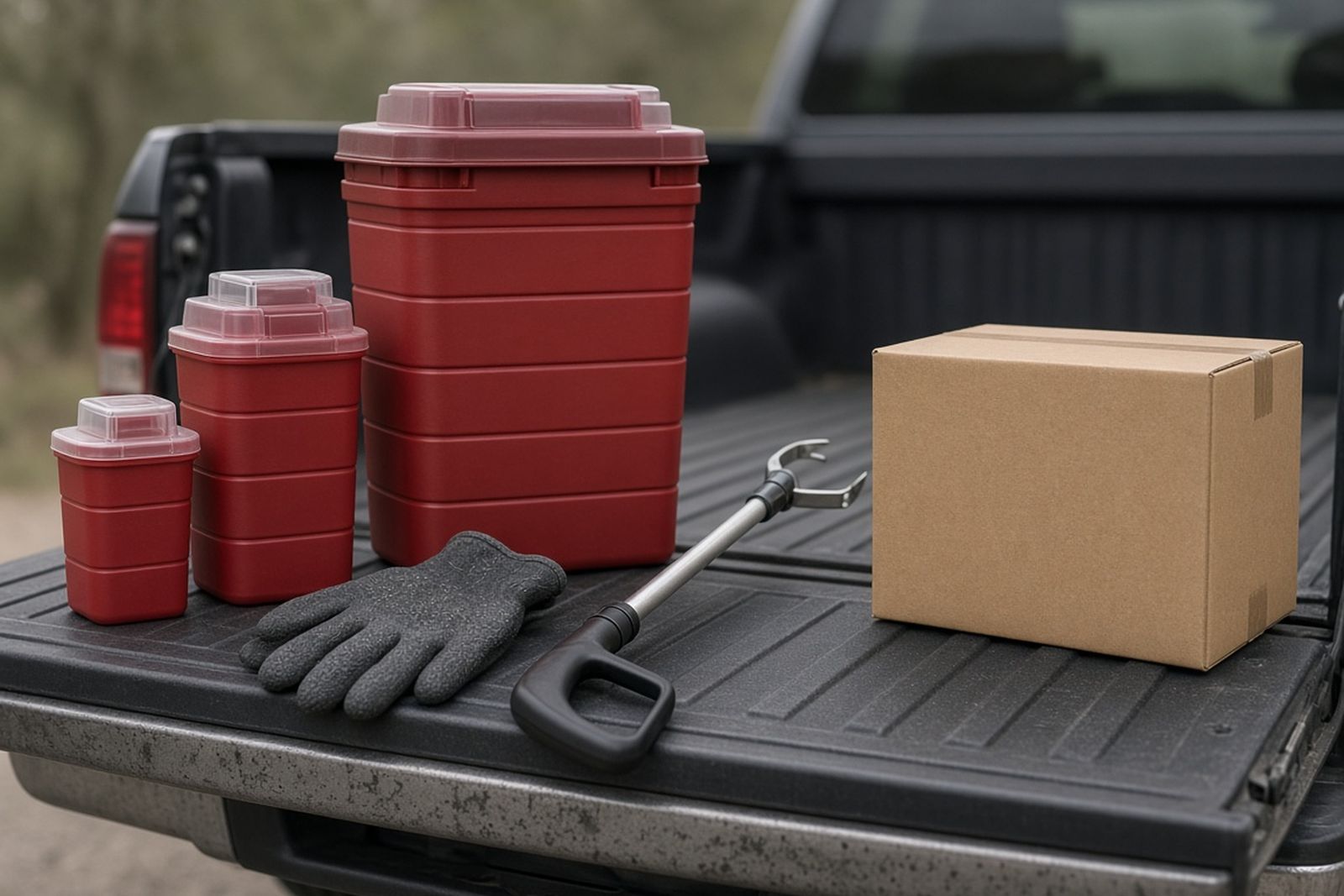
A proper sharps container is a piece of engineering. It is made from rigid, thick plastic that a needle point cannot easily pass through, even if the container is squeezed or dropped. The opening is designed to accept sharps without letting a hand in, and the lid locks closed so contents stay contained during transport.
Federal health guidance describes the same basic qualities: heavy plastic, a lid that closes tightly and resists punctures, a stable base that stays upright, resistance to leaks, and a clear hazard label. Stability matters because a container that tips easily spills sharps. Leak resistance matters because residual fluids should not seep out.
Workplace containers face similar expectations under federal workplace safety rules for bloodborne pathogens. A professional provider should be able to tell you which containers they use and why they suit your setting.
Substitutes deserve a quick word. A thick, opaque plastic bottle with a screw cap is sometimes suggested as a fallback when no purpose-made container is available, but glass jars, soda bottles, milk jugs, coffee cans, and paper cartons are poor choices. Glass shatters, thin plastic can be pierced, and metal lids may pop off in a compactor. If you are unsure what your area accepts, ask before you start filling anything.
After collection: treatment, and what it means on a pickup
Collected sharps are sent to treatment facilities that use methods designed to destroy pathogens and make the needles unusable. Common approaches include high-temperature steam treatment in an autoclave, often followed by shredding, and incineration. Some systems use other validated technologies. The details depend on the facility and what the state permits.
Treatment addresses both hazards at once. Heat destroys the biological risk. Shredding or burning destroys the physical risk by eliminating the sharp point. The end product can then be managed as ordinary solid waste in many areas.
In practice, state environmental and health agencies set most of the requirements for how sharps are stored, transported, and treated, so the right process in one state may differ from the next.
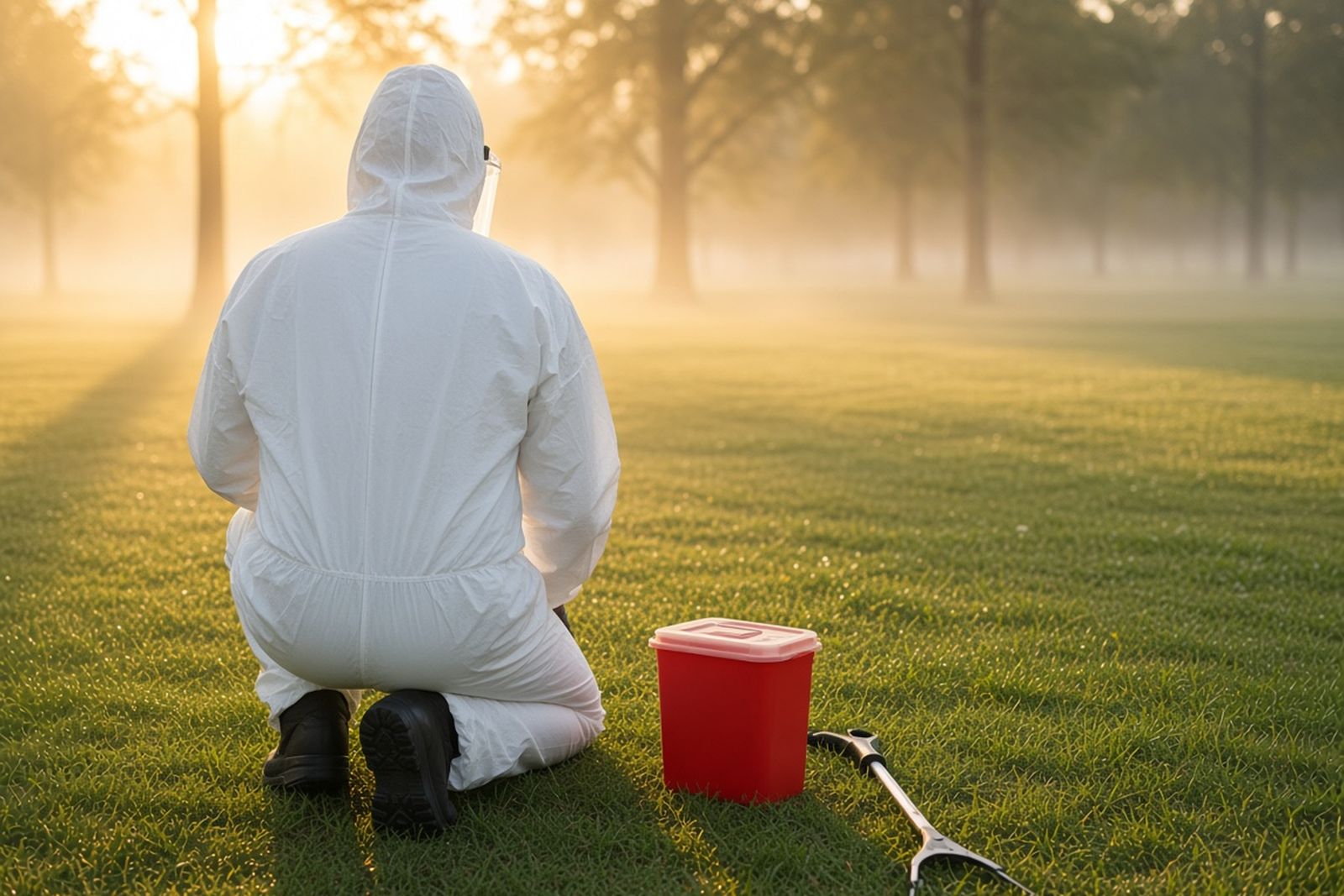
On an actual pickup, all of this translates into a few fixed habits. A trained technician treats every syringe the same, capped or not, because a cap may be loose and the needle beneath it still carries whatever it carried before. Each one is lifted with tongs and dropped point-first into a rigid container brought to the spot. Nobody tests the cap or checks the barrel for blood.
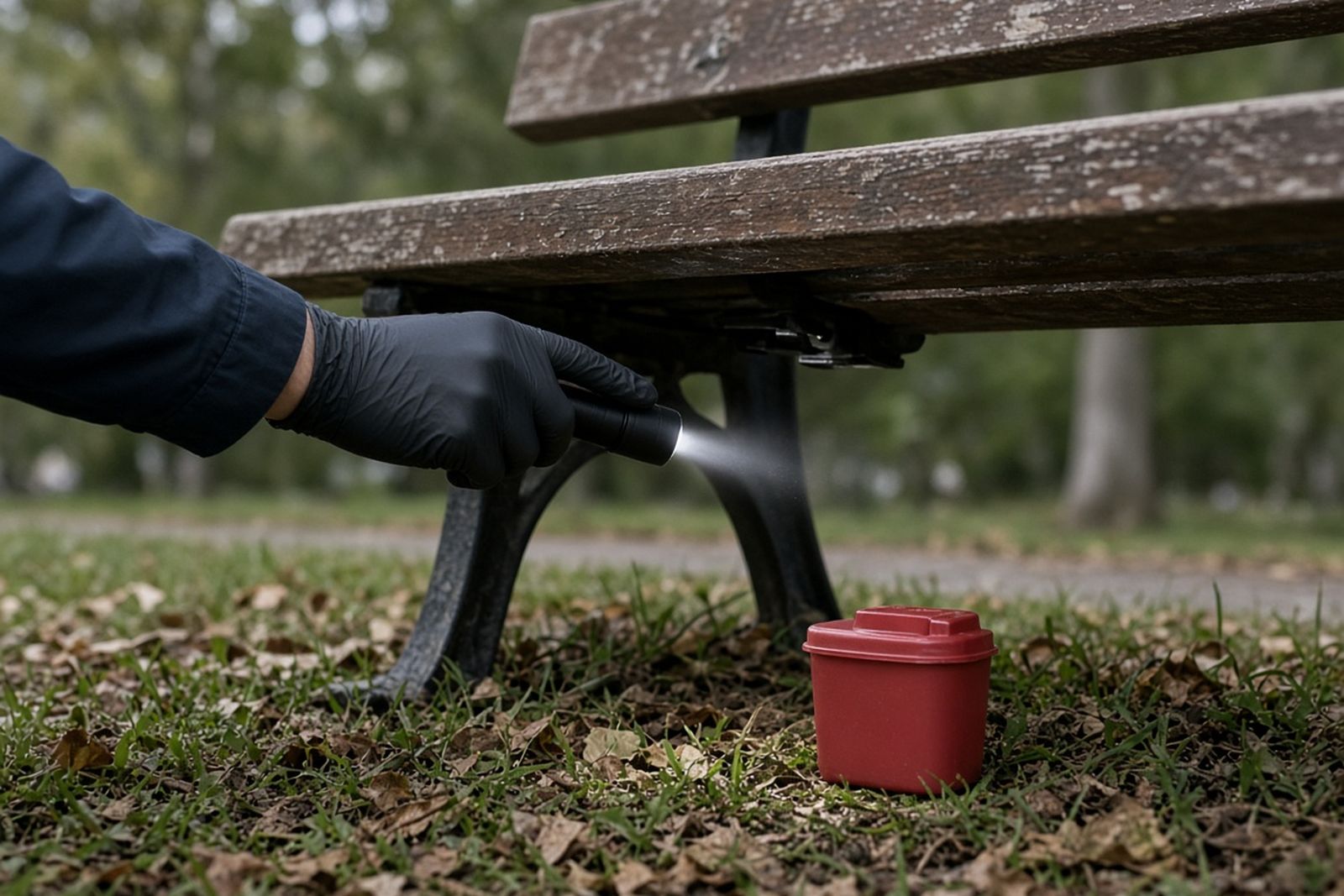
Because sharps are rarely found alone, the technician then searches the surrounding area, such as beneath bins, in mulch beds and along fence lines, raking gently in thin layers so buried needles surface rather than sink. The container is sealed at its fill line, labeled, and taken for treatment, and the client receives a count and a location map for their records.
Five habits the science points to
The science points to a few simple habits. Treat every used or found sharp as potentially infectious. Use tools, not hands, for any found needle. Use a real sharps container and stop filling it early. Keep sharps out of household trash and recycling unless your local authority specifically allows a sealed container there. And seek medical care after any stick.
If you manage a property or public space where needles keep turning up, a professional provider can handle the search and collection and give you records that help you plan prevention. If you use sharps at home for a medical condition, ask your pharmacy or local health department about take-back, drop-off, or mail-back options near you.
Finally, remember that the science protects people you may never meet. Every needle that reaches a proper container instead of a trash bag spares a sanitation driver, a recycling sorter, a janitor, or a child on a playground from an injury they did not see coming. Small, consistent habits at the point of disposal are what make the rest of the system work.