Knowledge check with explanations

Needle & Sharps Disposal quiz and study guide

Find out what you already understand, then read the parts you missed.

This quiz checks whether you can spot a sharps hazard, respond without touching it, and pick a disposal path your local office would accept. It is for renters, landlords, upkeep supervisors, parks staff, and homes that make medical sharps. The questions cover real moments. A syringe in a stairwell. A full container at home. A crew member who got stuck. A business owner deciding if a porter may pick up needles. There are no trick questions. But some answers sound right and are wrong, because the most common mistakes here feel like common sense. Take your time and read each scene. A wrong answer here is the safest place to learn.

Get an email reply about needle & sharps disposal

Send a short message to the follow-up inbox. A coordinator can reply by email. This form does not send emergency help; call 911 first if anyone is in danger.

Tell us what you need help with. Share a short description; please leave out medical details, access codes, and other sensitive information.

A request does not confirm a booking. For immediate danger, contact local emergency services.

Or email info@prompartybuses.com

The study guide below lays out the ideas the quiz uses. Read it first if you are new to this. Or use it afterward to see why an answer was right. Each section covers one idea. How to spot a hidden hazard. Who is expected to act. How to close off an area. Why cleaning a surface is different from disinfecting it. Where sharps go after pickup. And what records to keep. None of this replaces training for people who handle sharps at work, and it is not medical advice. It is meant to help you speak up better as a tenant, manager, or customer when you talk with a provider or local program.

Needle & Sharps Disposal knowledge check

15 questions about real needle & sharps disposal situations: staying safe, what happens, cost, choosing help and the rules. Every answer comes with a short explanation.

Why this quiz matters

Knowing these basics makes it easier to spot bad advice and ask a company the right questions. This quiz is educational — it does not certify anyone. After the quiz, review the explanations for questions you missed. For professional guidance on your specific situation, use the contact form at the top of the page for an email reply.

Progress1 / 15
SafetyQ1

You spot an uncapped syringe on the sidewalk outside your apartment building. What is the best first step?

Study guide: the six ideas behind the questions

Read these before or after the quiz. They cover the concepts every question draws on, written for needle & sharps disposal specifically.

1Recognizing a sharps hazard that is not in plain sight

The easy case is a syringe lying on pavement. The hard cases are the ones that hurt people. Think of a needle pushed into a couch cushion in an empty unit, or a lancet buried in sandbox sand. It could be a syringe inside a tied grocery bag by a dumpster, or a needle stuck between a car seat and the console. Anywhere people have slept, used drugs, or left belongings needs a slow look before hands go in. Treat any soft, loose, or layered stuff there as if it may hold a sharp until you know it does not. Camp ground, fallen leaves, and snow hide needles well. Spotting them is mostly about slowing down. Assume the hazard is there until a careful search says it is not.

2Who is expected to act when a needle is found

Whoever controls the space is usually responsible. On a rental property, the landlord or manager is generally expected to arrange removal from shared areas once told. Inside a tenant's unit, it can depend on the lease and how the sharps got there. At a business, the owner or facilities lead decides. In parks and on sidewalks, the city or a hired program usually responds. Private lots next to public land are often a gray area. Workers should never be told to pick up needles without the training, tools, and containers the Bloodborne Pathogens standard calls for. Rules vary by state and county. Check with the local office when it is not clear who is responsible.

3Isolating the area before anyone reaches for the needle

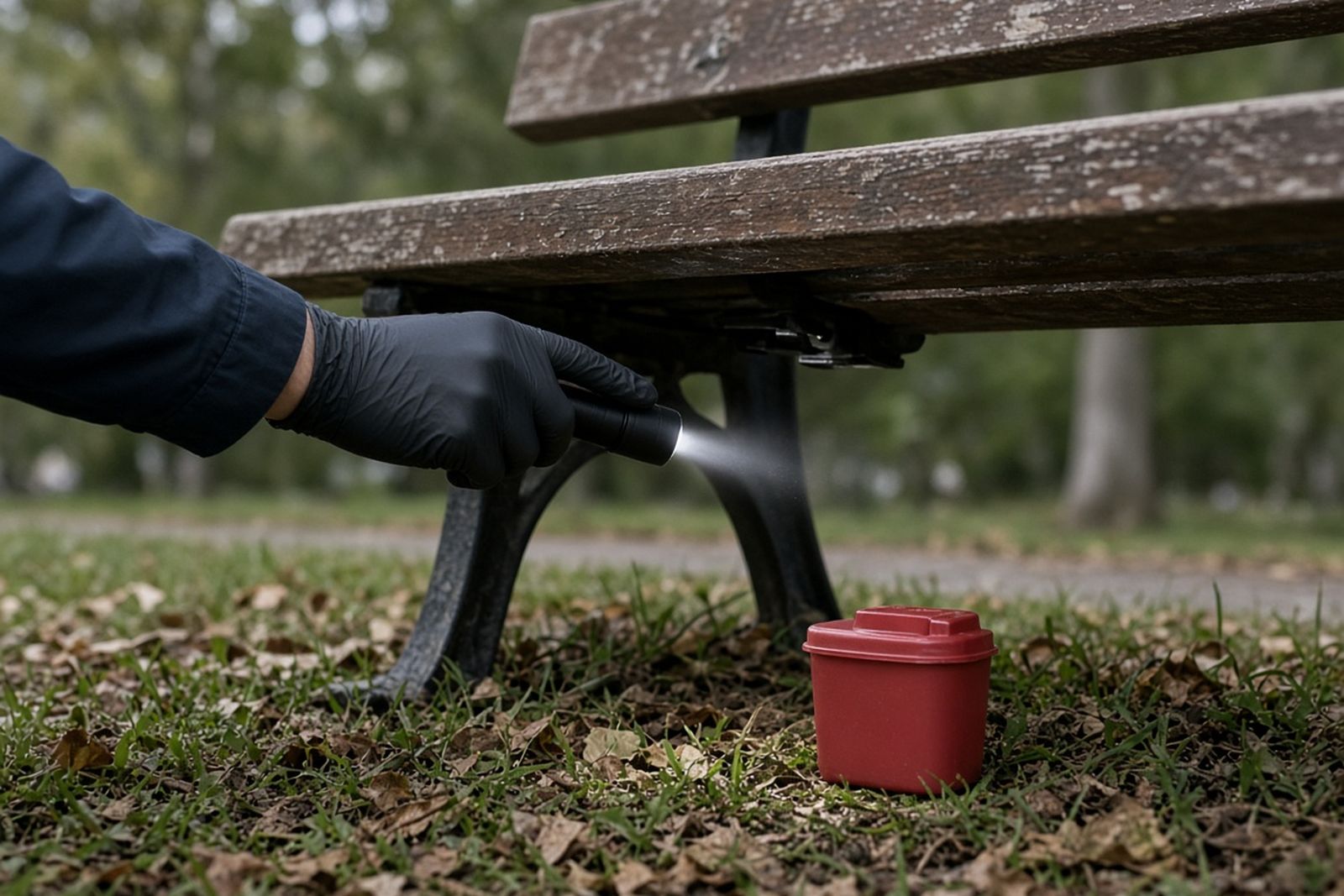
Closing off the area for sharps is simple and physical. Keep people, children, and pets away from the spot. Mark it with a cone, a chair, or tape if you can do that without stepping over the needle. Take a photo from standing height so a responder can find it. Do not cover the syringe with a bag or box. That hides it from the next person and makes it harder to pick up. If the area is a playground, sandbox, or lawn where more needles could hide, close off a wider zone. Treat the whole surface as suspect. Closing off the area costs nothing. It prevents the second injury that happens when a curious person tries to help.

4Cleaning a surface versus disinfecting it after a sharp is removed

Removing the needle is the first job. If there is blood or fluid you can see on the ground, a bench, or a floor, that is a separate concern. Cleaning means lifting the dirt away with soap and throwaway wipes. Disinfecting means using a product approved for the job, such as one on EPA List N for virus claims. You let it sit for the time on the label, on a surface you have already cleaned. Spraying disinfectant on dried blood without cleaning first does little. For soft items like carpet or couches with fluid on them, removal is usually the honest answer. A single needle with no fluid you can see often needs only removal and a wipe of that spot.

5Where sharps go after they leave the site

Picked-up needles belong in a stiff, labeled container that needles cannot poke through. Seal it before it reaches the fill line. Where it goes next depends on who made the waste. Home sharps may go to a community drop-off or a mail-back program. Where allowed, they may go in the trash, sealed. Sharps picked up by a business or provider are usually regulated medical waste. They travel with shipping papers to a permitted plant that sterilizes or burns them. Loose needles should never go in recycling, trash compactors, or soft bags. Ask any provider how the container will be moved and whether you will get proof of treatment. Waste rules vary by state and county, so check with the local office.

6Documenting the find and verifying the area is clear

Good records protect tenants, owners, and responders. Photograph the syringe where it lies before removal. Note the date and time. Keep any written notes you traded with a landlord or manager. After pickup, ask for a short note that says what was searched, what was found, and where the container went. For camps and playgrounds, checking means a second pass after junk removal, not a single glance. Magnets and metal detectors can miss syringes with plastic bodies, so looking by eye is still the standard. If someone was hurt, keep those details with the site record. Photos and disposal papers in the property file let a future buyer, auditor, or tenant see the problem was handled right.
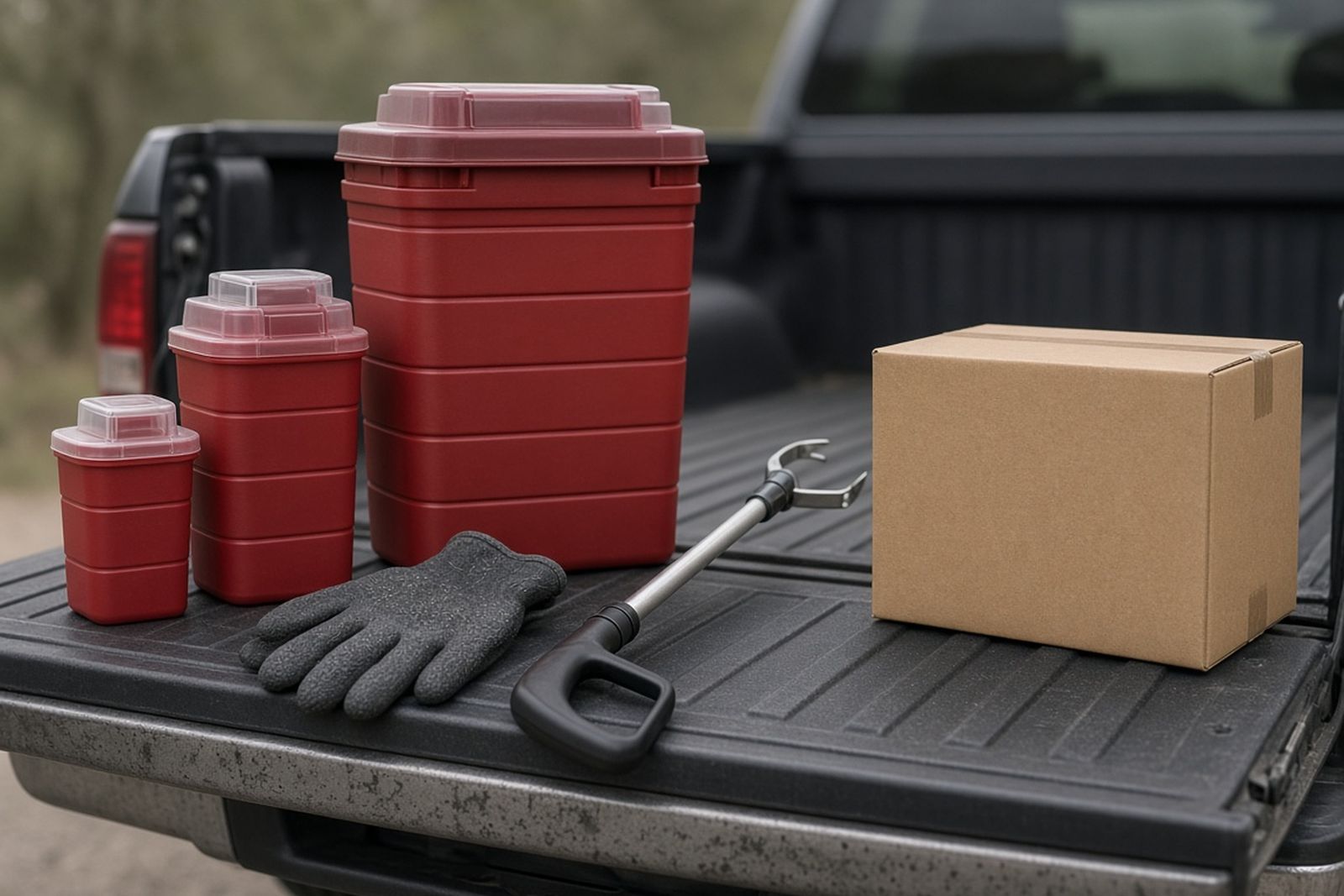
Sharps containers in three sizes, puncture-resistant gloves, tongs and a mail-back box on a truck tailgate
Illustrative photo, not a job record. Sharps containers in three sizes, puncture-resistant gloves, tongs and a mail-back box on a truck tailgate.

Needle & Sharps Disposal facts the quiz draws on

42 days

A Yale School of Medicine study found half of HIV-contaminated syringes stored at 4 C still contained viable virus at 42 days, versus under 1 percent after a week above room temperature.

Read with care: Laboratory conditions; survival depended heavily on temperature and residual blood volume, and the study is from 2000.

Source: Yale University (Substance Use and Misuse) (2000)Laboratory study of HIV-1 survival in syringes at different storage temperatures

5 features

FDA says a sharps container should be heavy-duty plastic, leak-resistant, upright and stable, with a tight-fitting puncture-resistant lid and a hazard label; a laundry detergent bottle can substitute if none is available.

Read with care: Improvised containers may not be accepted by all local drop-off or mail-back programs.

Source: FDA (2021)US consumer guidance for home-generated sharps

25.8%

25.8% discarded sharps without a designated sharps container.

Read with care: Self-report and single clinic; distinguish container use from final drop-off.

Source: Charbonneau et al. (2022)89 respondents at a US community care clinic.

7 days

According to CDC, hepatitis B virus remains infectious on environmental surfaces for at least 7 days.

Read with care: 'At least 7 days' is a floor; survival on a specific needle or surface varies with conditions.

Source: CDC (2024)General clinical guidance; surfaces contaminated with HBV-infected blood

These figures are public research and agency data, not this network's own job records. Keep each number with its population, year and limits; none of them predicts cost, timing or outcome at a specific property.

Questions about the needle & sharps disposal quiz

Does passing this quiz mean I am trained to collect needles?

No. The quiz tests whether you understand safe habits, who is responsible, and disposal paths. That helps you make better choices and ask better questions. Handling sharps as part of a job takes training from your employer. It also takes the right tools and containers, and steps that meet the Bloodborne Pathogens standard. If you are a resident, the quiz should remind you that your job is to close off the area, report, and record. It is not your job to pick it up.

Which quiz topics do people miss most often?

Two areas trip people up. The first is picking a container. Many people think any plastic bottle with a lid is fine, but thin containers are widely rejected. The second is who is responsible. Tenants often think they must handle a needle themselves. Landlords sometimes think tenants are responsible for shared areas. Both mistakes push people toward unsafe pickup. That is exactly what the quiz tries to prevent.

Is the quiz relevant if I only manage my own insulin needles at home?

Yes. One question covers sharps made at home. It explains which container to use, when to seal it, which programs may take it, and why needles should never go loose in home trash or recycling. The questions about found needles also help. A full home container that ends up in an alley dumpster becomes a public hazard for the next person.

Why does the quiz mention parking lots and rentals so often?

Those are the places where everyday people most often find used syringes with no warning and no training. Parking lots sit next to sidewalks and alleys where drug use happens. Rental turnovers expose whatever the last tenant left behind. Building questions around those places helps you practice the moment you find one. Then your first move will be to stop, close off the area, and report.

Can I use the quiz to train maintenance staff?

You can use it to raise awareness. But it does not replace the formal training anyone expected to handle sharps must have. A good approach is to have staff take the quiz and talk through the study guide together. Then adopt a written no-touch rule that tells them to report, not pick up. Give them a vendor contact so the next step is clear.

What should I do if I disagree with a quiz answer?

Check the study guide section the question is based on. Compare it with your local health department's advice. Rules about containers and disposal do vary by state and county. So your local program may accept something the quiz treats as generally not a good idea. Safety habits, such as never picking up by hand and never putting the cap back on, do not vary. Treat those as fixed.

Does the quiz cover what to do after a needlestick?

Briefly. The right steps are to wash the wound, get checked by a doctor right away, save the syringe if you can do it safely, and write down what happened. The quiz does not ask about specific treatments. Those choices belong to the doctor who checks the exposure. Its goal is to make sure nobody puts off care because they assume the needle was harmless.

What other visitors think

Poll results

Every count is a real visitor vote; nothing is seeded or padded. One vote per poll per device, and you can change your answer.

Your experience

If you found a syringe in a shared area of your building, what would you most likely do first?

No visitor votes yet
General

How do you currently manage medical sharps generated at home?

No visitor votes yet