Needle & Sharps Disposal: Education
Science and technology used in some needle & sharps disposal scopes, with explicit limits for ATP, disinfectants, enzymes, fogging, air equipment, and moisture tools.
The education articles explain the science and gear behind sharps pickup. They cover why a small amount of blood inside a used syringe can carry germs that spread through blood. They explain how long those germs may stay a concern outside the body. And they explain why the risk from any one needle is uncertain, not zero. Other posts look at what makes a container hard for needles to poke through. They cover how magnet sweepers and metal detectors do with plastic syringes, and when to disinfect a surface after removal. They also explain what steam and burning do to picked-up sharps once they reach a permitted plant.
Get an email reply about needle & sharps disposal
Send a short message to the follow-up inbox. A coordinator can reply by email. This form does not send emergency help; call 911 first if anyone is in danger.
This background helps you see why professionals follow strict steps and why some shortcuts fail. A thin plastic bottle may seem sturdy until a needle pokes through it in a garbage truck. A metal detector sweep may miss syringes with little metal in them. When you know what each tool and container can and cannot do, you can judge whether a provider's plan fits the site. The education posts also clear up common myths. One is that a needle left outside for a while is harmless. Another is that putting the cap back on a syringe makes it safe to throw away.
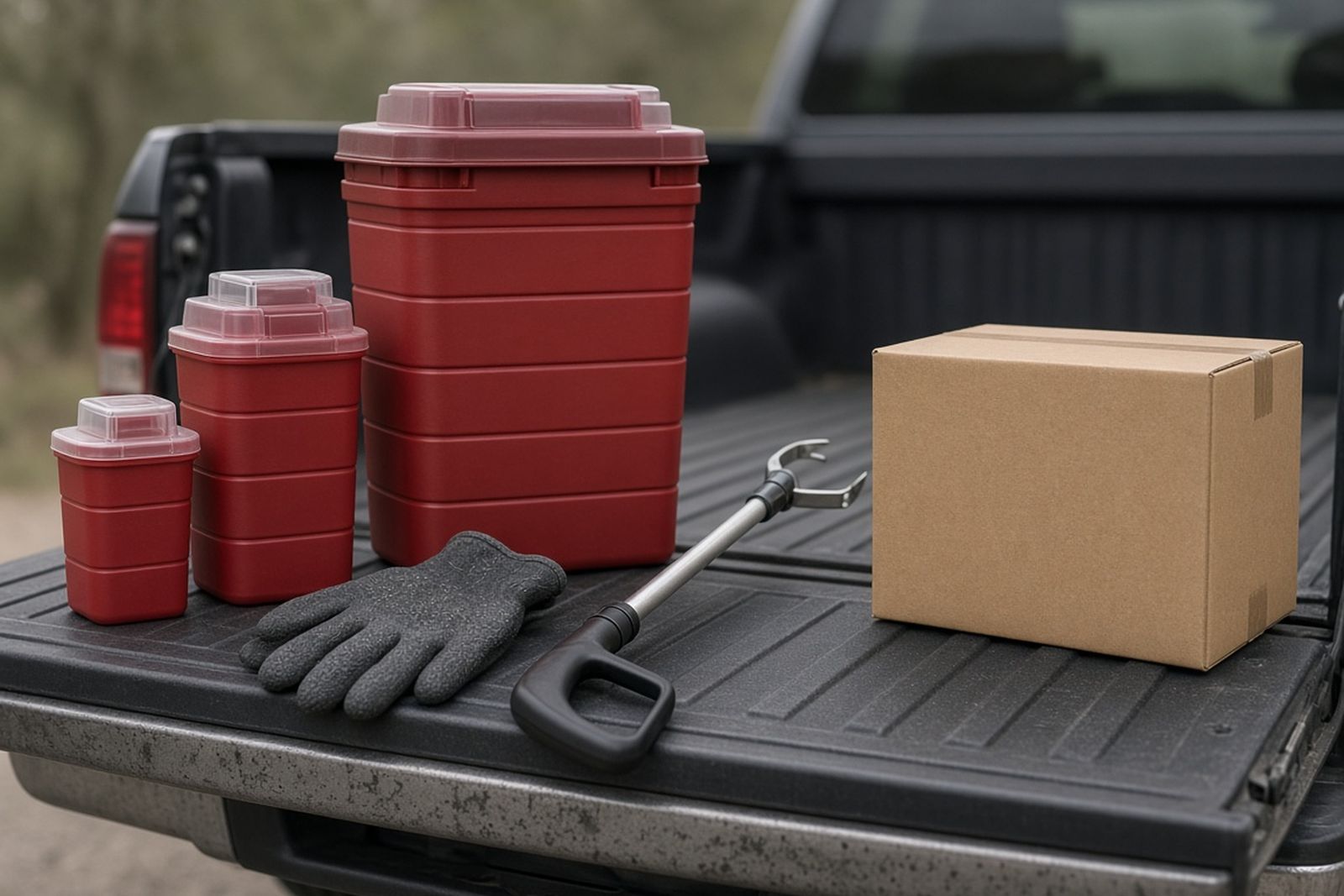
The Science Behind Needle & Sharps Disposal
Hollow needles, trapped blood, and puncture-resistant plastic: the biology and physics that explain why sharps disposal follows such strict, specific rules.
The science of sharps disposal comes down to three facts. Hollow needles can hold a small amount of blood where viruses stay protected for days or weeks. Most injuries happen during handling, especially recapping and overfilled containers. And only rigid, puncture-resistant containers followed by heat or incineration treatment reliably break the chain from a used needle to the next person.
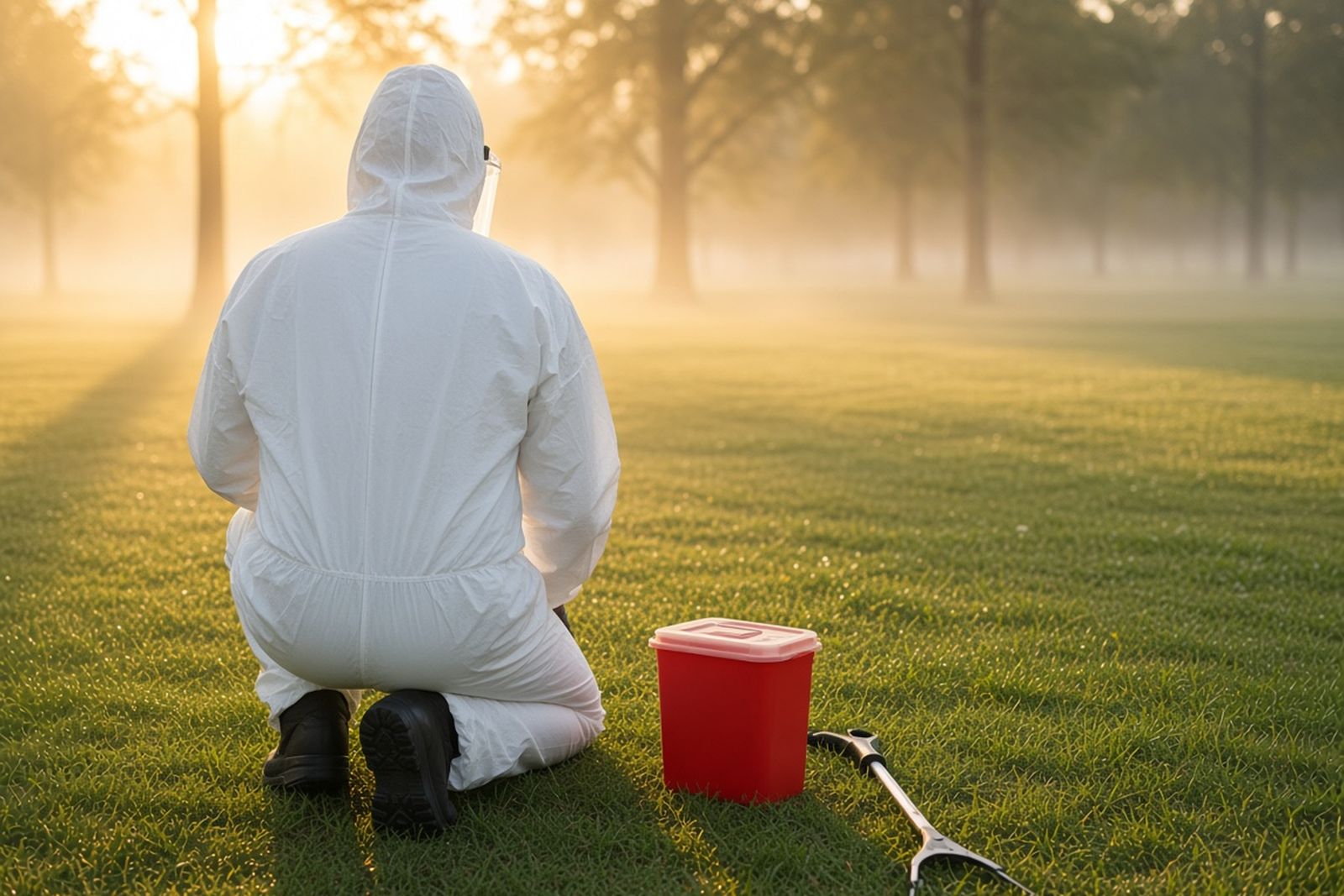
How to Evaluate Equipment Proposed for Needle & Sharps Disposal
Grabbers, rakes, container sizes, wall kiosks, and pickup logs: how to tell whether a sharps provider's equipment will keep your staff and residents safe.
To evaluate equipment for needle and sharps disposal, look for no-touch pickup tools, rigid puncture-resistant containers sized for the job, search tools suited to your ground cover, protective gear that does not replace safe technique, secure transport packaging, and a reliable way to record what was collected. For ongoing needs, ask about wall-mounted units or disposal kiosks and how often they are serviced.
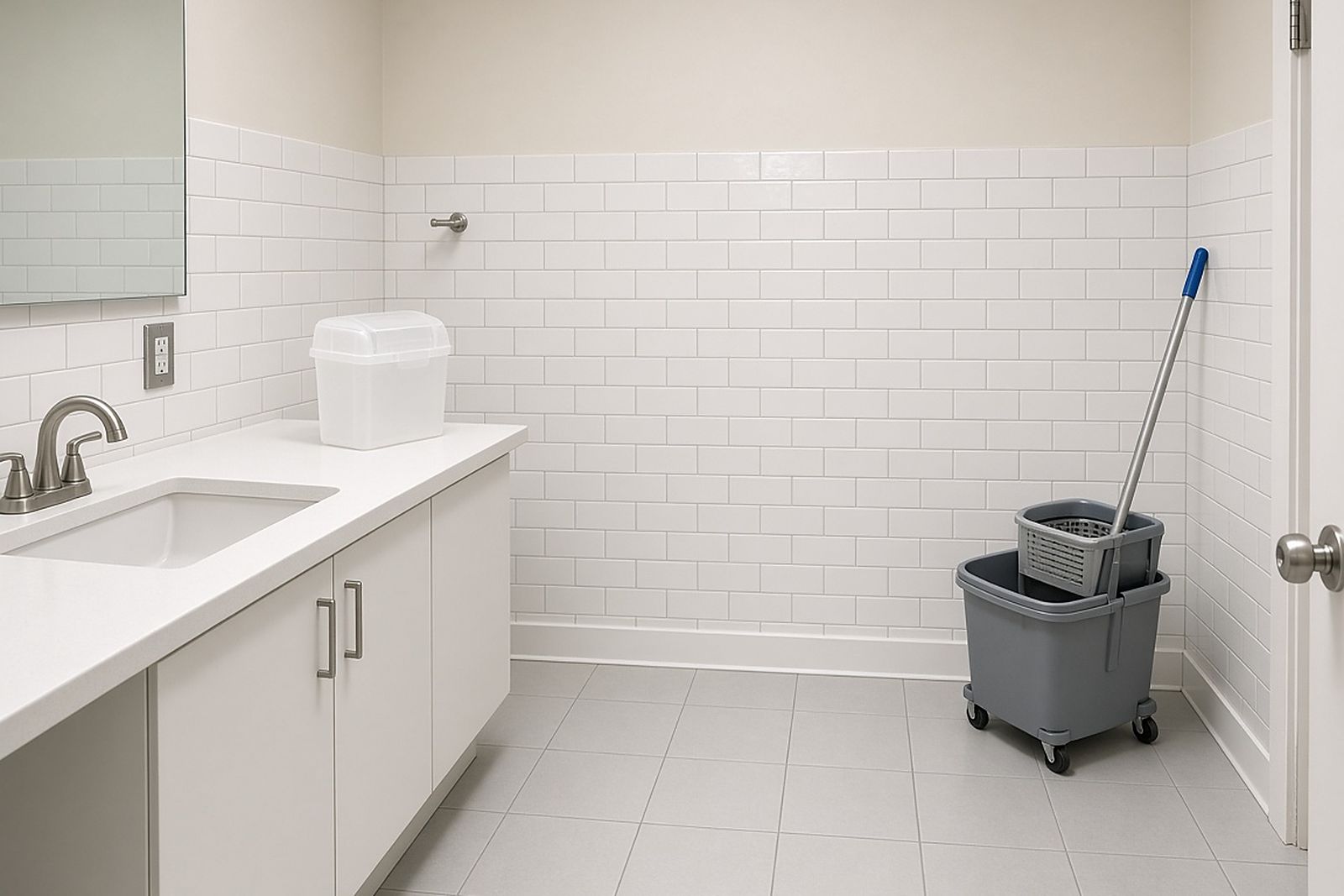
The Difference Between Cleaning and Disinfection in Needle & Sharps Disposal
Needles are contained and destroyed, not cleaned. Learn where cleaning and disinfection fit in sharps work: the surfaces, tools, and spills left behind.
In sharps work, the needles themselves are never cleaned or disinfected for reuse; they are placed in puncture-resistant containers and sent for proper disposal. Cleaning and disinfection apply to what surrounds them: surfaces with blood or residue, reusable tools, and container exteriors. Cleaning removes visible soil first, then an EPA-registered disinfectant used according to its label kills remaining germs.
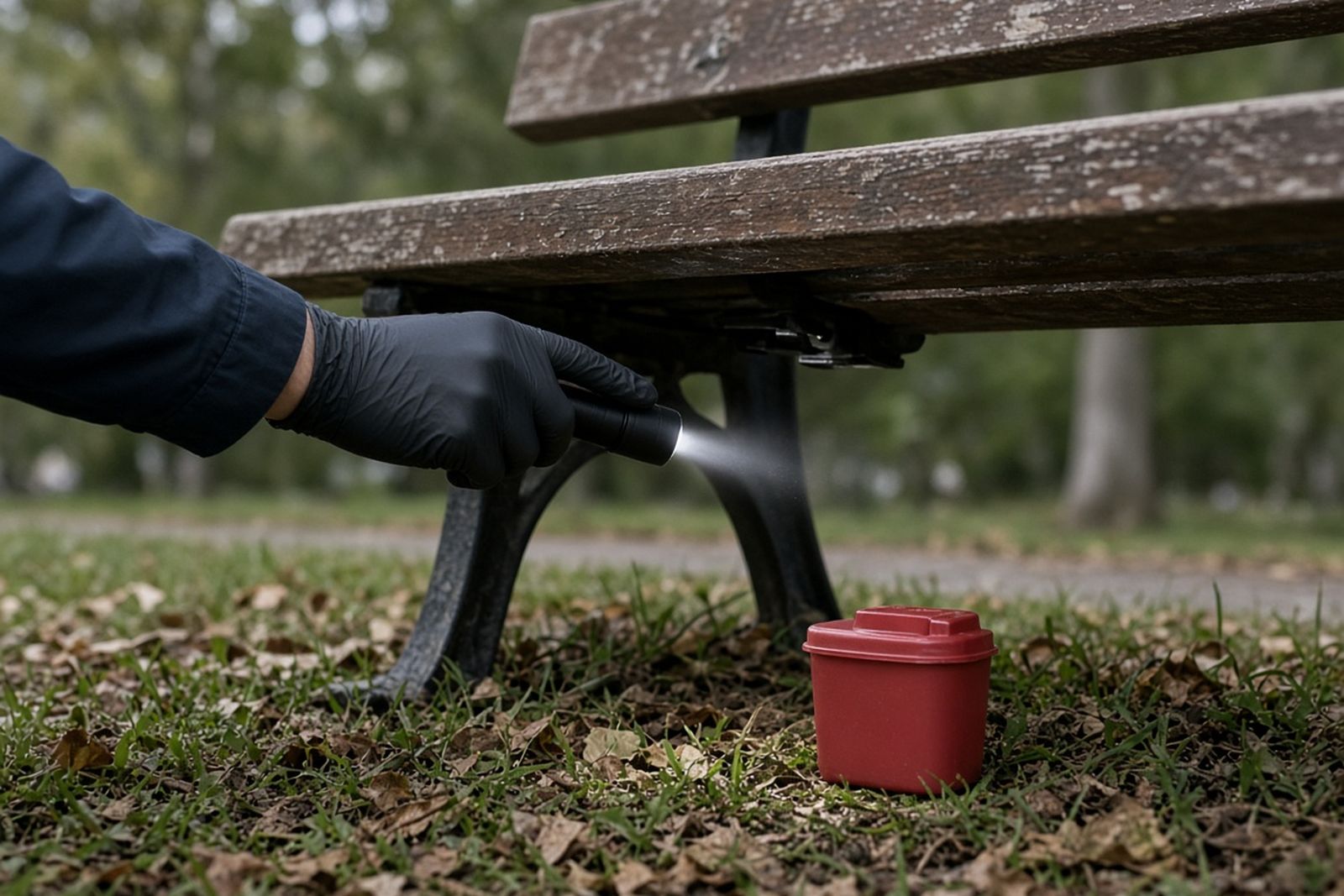
When ATP Testing Helps—and When It Does Not—in Needle & Sharps Disposal
An ATP swab can show whether a restroom counter still holds organic residue after a syringe find. It cannot tell you whether every needle has been found.
ATP testing measures organic residue on a hard surface, so it can help confirm that a blood-stained sink, counter or floor was cleaned well after a syringe incident. It cannot detect needles, identify viruses or clear a lawn, gravel bed or parking lot. For most sharps jobs, a documented search pattern, proper containers and licensed disposal matter far more than a swab reading.
How to Evaluate Technology Used in Needle & Sharps Disposal
Magnetic sweepers, mapping apps, smart kiosks and needle destruction devices all promise better sharps pickup. Here is how to judge which tools actually help.
To evaluate technology in needle and sharps disposal, ask what specific problem it solves, what it cannot detect, how it fits a trained crew's search and a licensed disposal route, and what evidence backs its claims. Useful tools include proper grabbers and containers, good lighting, mapping and reporting apps, and public kiosks. No gadget replaces a careful, documented human search.
When Enzymes or Microbial Products Fit Needle & Sharps Disposal
Enzyme and microbial cleaners can help with urine and organic stains at a needle site, but they never make a syringe safe or replace a registered disinfectant.
Enzyme and microbial products have a narrow role in needle and sharps work. They can help break down urine, vomit and other organic residue on concrete or in stairwells after sharps are collected, which reduces odor and staining. They do not disinfect, do not make needles safe to handle and never replace puncture-resistant containers, a registered disinfectant for blood, or licensed disposal.
Sourced figures on education
- 13%
13% of reported used syringes were improperly disposed of in San Francisco versus 95% in Miami.
Read with care: Cities differ in many ways; Miami baseline overlaps S062.
Source: Tookes et al. (2012)San Francisco and Miami selected-neighbourhood walkthroughs; 602 and 448 interviewees respectively.
- 0.613
Adjusted risk of improper disposal was lower after implementation (aRR 0.613; 95% CI 0.546–0.689).
Read with care: Selected drug-affected areas; secular changes possible; baseline overlaps S063.
Source: Levine et al. (2019)Miami neighbourhood walkthroughs plus 448 pre-programme and 482 post-programme survey respondents.
- 78%
78% had noticed a public syringe-disposal box.
Read with care: Selected neighbourhood; disposal-box users are not necessarily people who inject drugs.
Source: Roth et al. (2021)358 residents and 78 business respondents in Kensington, Philadelphia.
These figures are public research and agency data, not this network's own job records. Keep each number with its population, year and limits; none of them predicts cost, timing or outcome at a specific property.
What research has found
Findings from published studies of people and properties in situations like this one. They describe what researchers observed in a specific group; they are not predictions for your case.
Frequently finding drug-containing syringes was associated with higher adjusted injury odds.
The city difference persisted after statistical adjustment, but does not isolate programme causality.
Education: common questions
Are needles left outside for a long time still dangerous?
They should always be treated as hazardous. Weather and time may shorten how long some germs survive, but conditions vary. There is no reliable way to know how long a needle has been there or what it held. Any found syringe should be handled only by trained people who use tools and approved containers.
Can a metal detector find every needle in the grass?
No. Many syringes have small needles or mostly plastic bodies. Detectors can miss them in thick grass, in mulch, or near metal fences. A careful search by eye, in overlapping passes, is still the main method. Tools such as magnet sweepers can help. But they add to a careful search. They do not replace it.
What happens to sharps at a treatment facility?
Picked-up sharps are usually treated with methods like an autoclave, which uses steam under pressure, or burning. They may also be shredded so no one can tell what they were. The plant's permits and methods depend on the state. Providers can often give you papers that show treatment took place. Keep that record in your property file.
Why do found needles so often come with caps, cookers, or other items?
Needles are often thrown out together with the other supplies used with them. So crews often find caps, cotton, wrappers, and small containers nearby. Those items can carry blood or residue and may hide more needles underneath. That is why a responder searches the whole cluster instead of lifting only the syringe they can see. It is also why junk removal is often part of the job.
What is the difference between a syringe, a pen needle, and a lancet?
A syringe has a tube and plunger attached to a hollow needle. It is used to inject liquid. A pen needle is a small needle that screws onto a reusable or throwaway injection pen. A lancet is a tiny blade or point used to prick the skin for a blood sample. All three count as sharps and belong in a container needles cannot poke through.
Can needles hide inside everyday objects like shoes or bags?
Yes. Needles are sometimes tucked into shoes, pockets, backpacks, purses, and bedding. This is common in empty units and camp areas. That is why responders never reach blindly into any soft item. Instead, they open or tip it carefully with tools. If you are clearing belongings, look before you reach. Set aside anything you cannot see into for a trained person.
Why is recapping a used needle discouraged?
Guiding a thin needle back into a small cap takes a steady hand. A small slip can drive the point into the hand holding the cap. Many sticks happen exactly this way. It is safer to drop the uncapped needle straight into a sharps container. If you find a capped needle, handle it as if it were uncapped, since the cap can come loose.
Related community polls
Every count is a real visitor vote; nothing is seeded or padded. One vote per poll per device, and you can change your answer.
If you found a syringe in a shared area of your building, what would you most likely do first?
How do you currently manage medical sharps generated at home?
More on needle & sharps disposal
Needle & Sharps Disposal services
See how field pickup, container swaps, camp sweeps, and regulated transport fit together when used needles turn up on a property.
Costs explained
What drives the price, published cost ranges, and how to read a written quote line by line.
Insurance and payment
Which policies may respond, how to document a claim, and what to do if coverage is denied.
Planning tools
Work through cost ranges, provider questions, claim steps, first-day actions, waste types, and a DIY risk check built for found needles.
Community polls
Compare your gut sense with other renters, landlords, and parents on how to report, pay for, and check sharps cleanup in shared spaces.
Knowledge quiz
Test whether you can spot hidden sharps, know who is responsible, and pick a disposal route your local office would accept.