Short answer
ATP testing measures organic residue on a hard surface, so it can help confirm that a blood-stained sink, counter or floor was cleaned well after a syringe incident. It cannot detect needles, identify viruses or clear a lawn, gravel bed or parking lot. For most sharps jobs, a documented search pattern, proper containers and licensed disposal matter far more than a swab reading.
An ATP swab reading, in plain terms
ATP stands for adenosine triphosphate, a molecule found in living cells and in the organic residue they leave behind, including blood, skin cells, food and body fluids. An ATP test uses a swab and a handheld reader called a luminometer. The swab is rubbed over a defined area, placed in the reader, and a chemical reaction produces light in proportion to the ATP present.
The result is a number in relative light units. Higher numbers suggest more organic material on the surface. Lower numbers suggest a cleaner surface. Each device brand uses its own scale, so a reading from one meter cannot be compared directly with another's.
What the test does not do is just as important. It does not identify any particular germ, cannot distinguish living from dead cells in a meaningful way for your purposes, and does not tell you whether hepatitis or HIV is present. It is a cleanliness indicator, not a pathogen test.
What a swab cannot tell you: needles and viruses
This is the most common misunderstanding, and it matters. A needle is a physical object. Confirming that an area is free of sharps depends on how carefully someone searched, not on what a swab picks up from a surface.
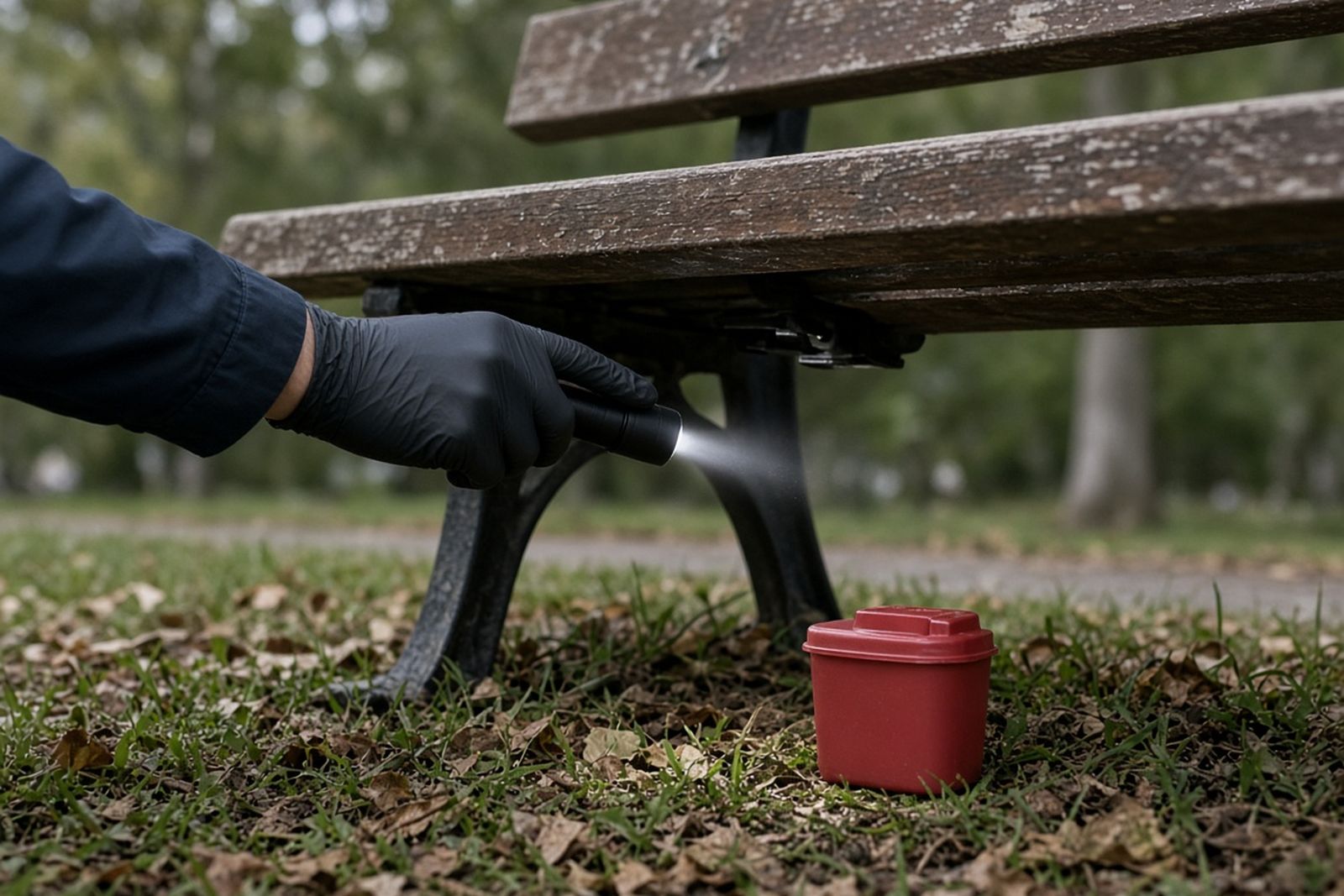
A swab cannot find a syringe buried in mulch, wedged behind a toilet tank or lying under leaves along a fence line. It cannot tell you whether a cap-less needle rolled into a storm drain grate. Those answers come from a systematic, documented search by a trained technician with adequate light, tools and time.
If a provider offers ATP readings as proof that a park, lot or alley is clear of needles, ask them to explain what the swab could possibly measure in that setting. The honest answer is that it cannot measure the thing you care about most.
Viruses are a similar story. It is natural to want a test that answers the real worry: is anything infectious left behind? In practice, routine lab testing of surfaces for bloodborne viruses is not how sharps sites are cleared, and it would rarely change what the crew does.
The reason is that the response is the same whatever the source. Any blood or used needle of unknown origin is treated as potentially infectious. The crew collects the sharps, removes visible contamination, cleans and then disinfects with a product registered for the relevant organisms, following its label. A lab result days later would not make that work more thorough.
Testing people is a different matter. If someone was stuck by a discarded needle, the priority is prompt medical evaluation for that person. A clinician decides what testing and preventive treatment make sense. Testing the needle itself is generally not something you should attempt, and handling it to send it off only creates another chance of injury.
So when a provider offers extra testing, ask what decision the result will support. If the answer is none, the money is better spent on a more careful search or a follow-up visit to check for new finds.
Where ATP testing genuinely helps
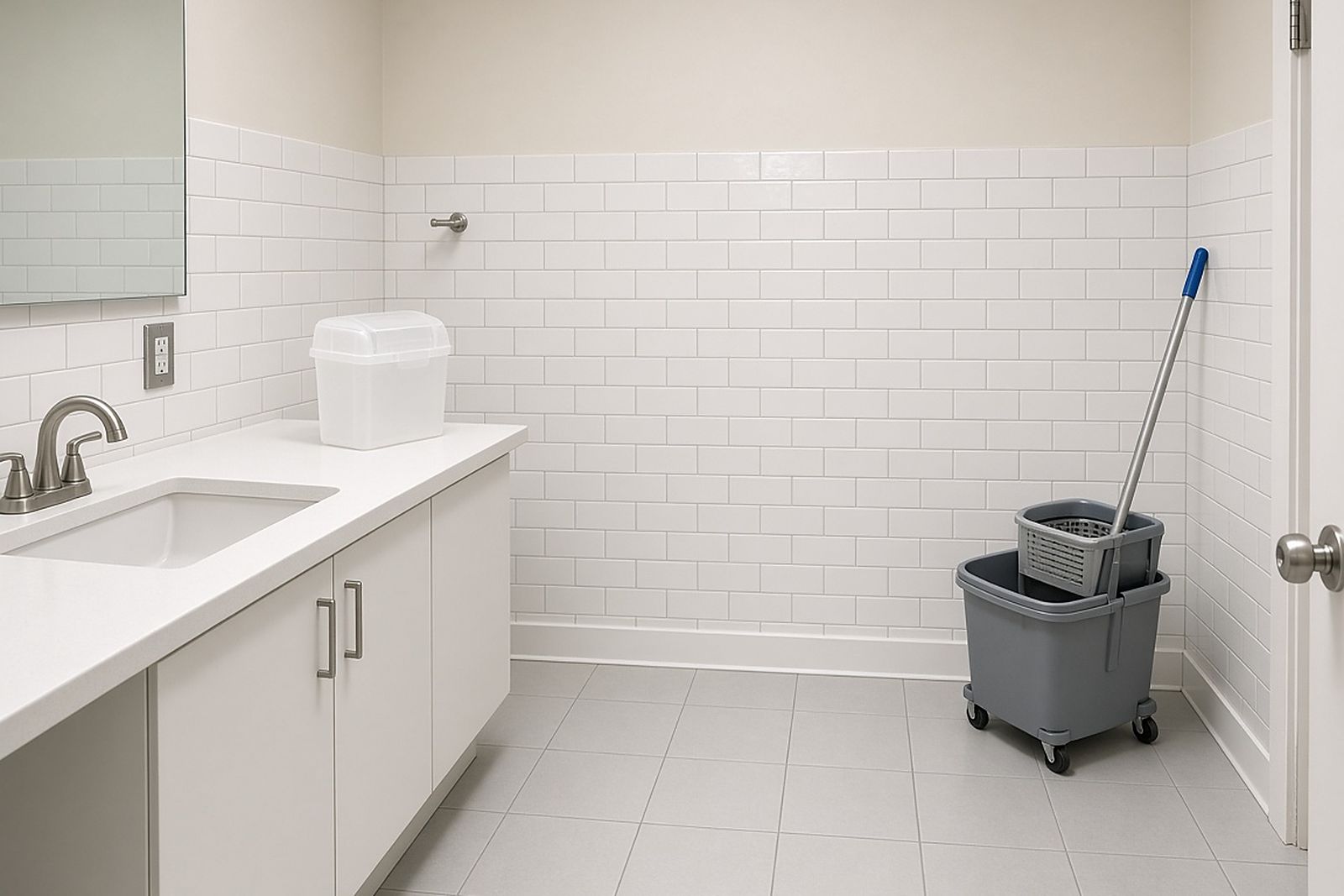
ATP testing earns its place when a syringe find comes with visible blood or body fluid on a hard, nonporous surface. Think of a restroom where someone injected and left blood on the sink rim, the toilet seat, the partition and the floor tile. After the sharps are collected, those surfaces need cleaning and disinfection, and a swab can help confirm that the cleaning step removed the organic load.
That confirmation matters because disinfectants work best on clean surfaces. Blood and other organic matter can shield germs and interfere with some disinfectants. A low reading after cleaning suggests the surface is ready for the disinfectant to do its job; a high reading tells the technician to clean again before disinfecting.
Blood that is merely wiped around rather than removed is not a finished job, and a swab is one way to catch that before the disinfectant goes on.
Used this way, the test becomes a quality check on the crew's cleaning work in a specific, defined area. It is not a verdict on the whole property, and it is not a statement that the space is free of infectious agents.
The surface matters, too. ATP readings are most reliable on smooth, hard, nonporous surfaces where a swab can cover a consistent area. Readings become unreliable or meaningless on rough, porous or naturally organic surfaces.
Outdoor sharps work lands almost entirely in the second group. That is one reason reputable providers rarely lead with ATP data for exterior sweeps.
- Useful: stainless steel fixtures, sealed countertops, glazed tile, toilet partitions, plastic changing tables and vinyl seating.
- Limited: sealed concrete and painted walls, where texture affects how much residue the swab picks up.
- Not useful: soil, mulch, grass, gravel, carpet, unsealed wood, cardboard and fabric.
- Misleading: any surface with naturally high organic content, such as a planter bed or compost area.
How should a provider use ATP testing?
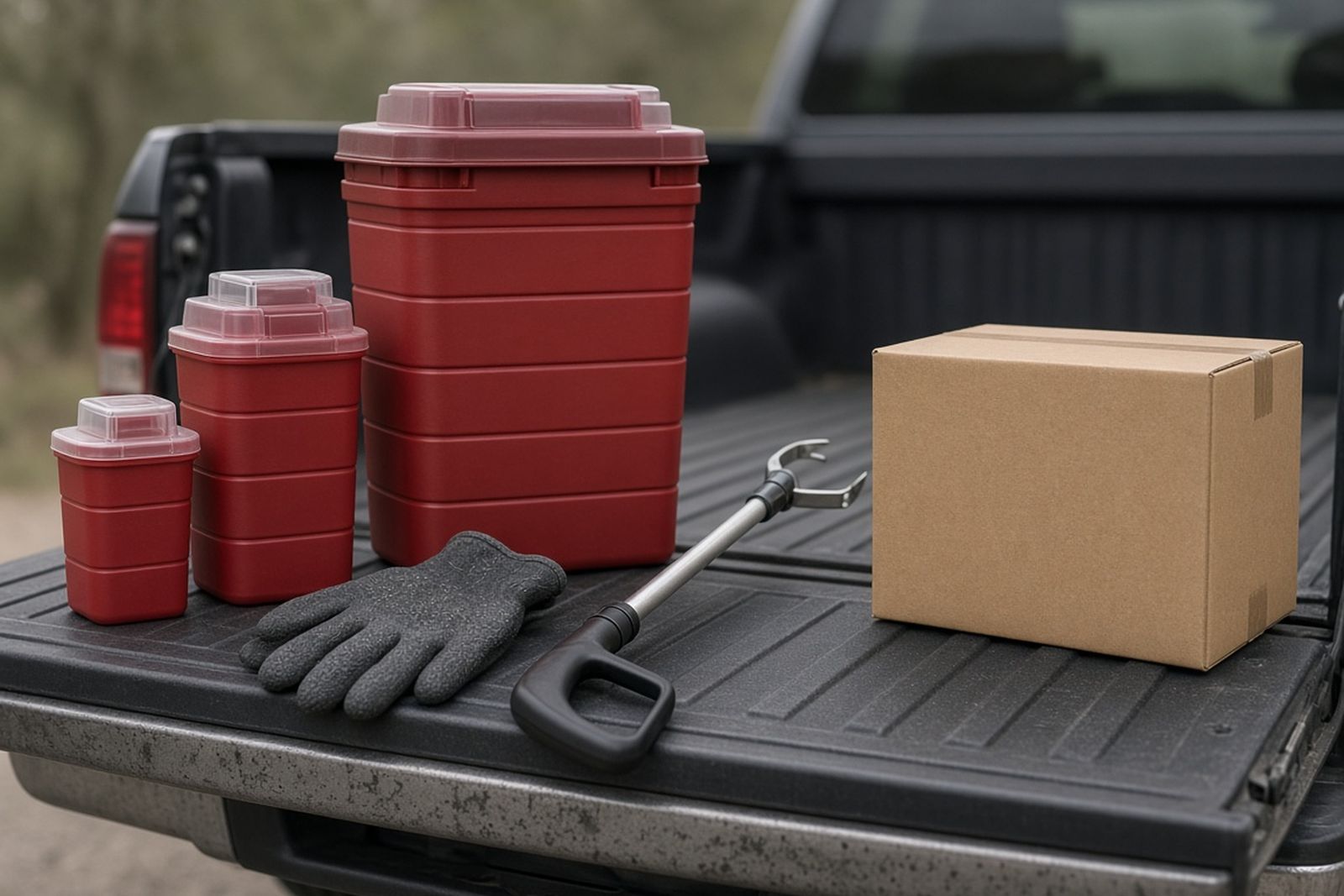
A thoughtful provider treats ATP testing as one tool in a larger process. The sequence normally runs: secure the area, search and collect sharps into approved containers, remove visible contamination, clean, swab, re-clean if needed, then disinfect for the product's full label contact time.
Some crews also swab before cleaning to show how much the reading drops afterward. That before-and-after comparison is more informative than a single number, because it shows the effect of the work on that specific surface.
Ask how the provider chooses where to swab. Good practice focuses on the surfaces that were visibly soiled or most likely touched, and records the exact spot so a later test can be taken in the same place. Random swabs of clean areas can produce reassuring numbers that say little about the problem zone.
Finally, ask what pass level they use and why. Because there is no universal standard across devices, the provider should be able to explain the threshold their meter maker recommends for the type of surface involved.
Better verification for outdoor sweeps
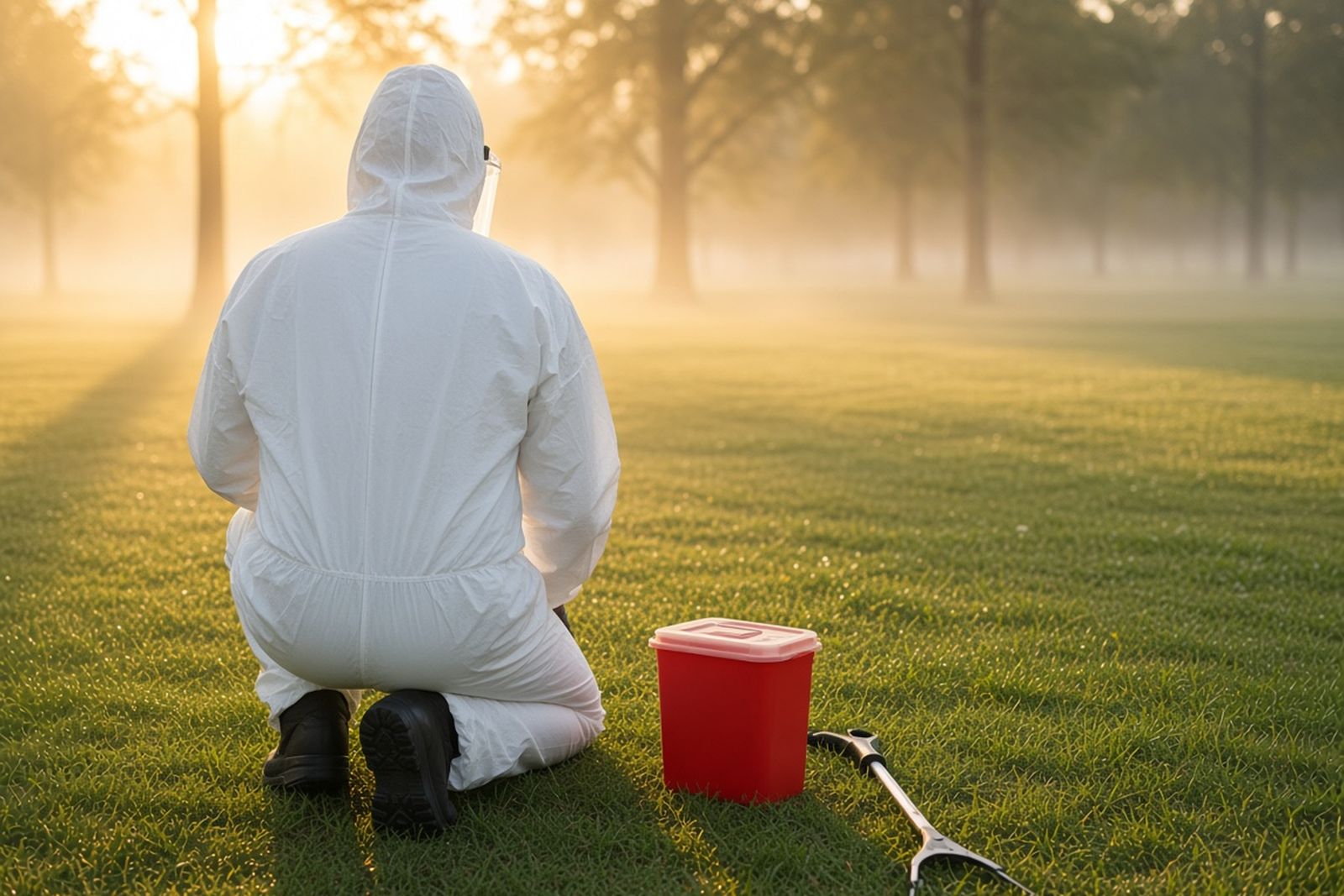
For lawns, lots, alleys, encampment areas and landscaping, verification is about the search, not a swab. The most useful proof is a record that shows how the area was covered and what was found.
You may also hear about metal detectors or magnetic sweepers. They can help in some conditions, but they miss plastic syringe bodies and caps and can be confused by other metal debris. Treat them as supplements to a careful visual search, never as replacements.
- A map or sketch showing the boundaries of the searched area.
- The search method, such as grid lines or overlapping passes.
- Counts of sharps collected and where clusters were found.
- Photos of the area before and after, including hidden spots checked.
- The container type used and the licensed disposal route for the waste.
Worked through: a gas station restroom
The restroom described here is illustrative rather than a real job. Suppose a gas station clerk opens the single-occupancy restroom and finds two syringes on the floor, a used cotton on the sink edge and blood smeared on the sink and the wall beside it. The clerk locks the door and calls the owner, who calls a sharps provider.
The technician first collects the syringes and the cotton into a puncture-resistant container, then checks behind the toilet, inside the paper towel dispenser, under the trash liner and above the drop ceiling tile that sits slightly ajar. A third syringe turns up above the tile. No swab would have found it.
With the sharps secured, the technician cleans the sink, wall and floor, swabs the sink rim and the wall area, and gets a reading that is still elevated on the wall. After a second cleaning pass, the reading drops. The technician then applies a registered disinfectant for its full contact time and gives the owner a short report listing all three sharps, the hidden location, the before and after readings, and the disposal route.
The ATP numbers are a useful footnote in that report. The most important line is the third syringe.
Five questions for a provider who offers swab readings
ATP testing is not a bad thing to include. It simply needs to be matched to the right surfaces and described honestly. A few questions will tell you whether a provider understands that.
If the answers are vague, or if the provider suggests that a swab result means the area is safe for children to play in, look elsewhere.
- Which surfaces on my property will you swab, and why those?
- Will you take readings before and after cleaning?
- What pass level do you use for this surface, and where does it come from?
- How will you document the physical search for sharps separately from the swab results?
- Where will the collected sharps be taken for disposal?