Short answer
Needle and sharps disposal has shifted from casual trash disposal to a structured practice built on puncture-resistant containers, workplace bloodborne pathogen rules, state-run medical waste regulation, home disposal programs, and public drop boxes. Today, professional sharps collection also relies on search patterns, detailed pickup logs, and prevention advice, because discarded needles in public spaces became a visible community concern.
Before modern rules: coffee cans and trash bins
For much of the twentieth century, a used needle was treated like any other small piece of waste. Clinics had disposal routines, but they were inconsistent, and the concern was more about sterility of new equipment than about the hazard posed by used equipment. Recapping by hand was common, and sharps often traveled in ordinary trash to landfills.
At home, people who injected medication improvised. A coffee can, a cardboard box, or a plastic bottle held used needles until someone threw it away. Nobody tracked what happened next, and sanitation workers absorbed the risk without much discussion.
That arrangement held because the risk was poorly understood outside hospitals. The shift came when bloodborne infections became a public concern and when used medical items began turning up in places they plainly did not belong.
The 1980s turning point
The spread of HIV and wider awareness of hepatitis B and C in the 1980s transformed how people thought about a used needle. Suddenly the object was no longer just sharp. It was a possible route for serious infection, and that understanding reached far beyond hospital walls.
Healthcare facilities began adopting universal precautions, which meant treating blood and certain body fluids from every patient as potentially infectious. That mindset led directly to rigid sharps containers placed at the point of use, so a nurse could drop a needle in immediately instead of carrying it across a room.
At the same time, reports of medical waste washing up on beaches drew national attention to what happened after waste left the building. The public began to ask not only how needles were used, but where they ended up.
Who took responsibility for medical waste?
Congress responded to the beach-waste episodes with a temporary tracking program. According to the EPA, the agency has had no specific federal authority over medical waste since the Medical Waste Tracking Act of 1988 expired in 1991. That short experiment tested how waste could be tracked from generator to disposal, then ended.
Since then, states have carried most of the responsibility. Some wrote detailed medical waste laws with permits, tracking forms, and treatment standards. Others set lighter requirements. That patchwork still shapes sharps disposal today, and it explains why a practice that is required in one state may be optional across the border.
For anyone hiring a sharps service now, the practical result is simple: your state health or environmental agency, not a federal office, decides which permits, containers, and disposal routes apply where you are.
Worker protection on a separate track
Worker protection developed on its own path. OSHA's Bloodborne Pathogens Standard set out employer duties for anyone with occupational exposure to blood: exposure control plans, training, protective equipment, hepatitis B vaccination, and specific requirements for sharps containers.
Later federal legislation strengthened those rules by pushing healthcare employers toward safer devices, such as retractable needles and shielded syringes, and by requiring them to involve frontline workers in choosing equipment. Those engineering controls reduced some injuries at the source.
The same principles eventually spread to workers outside hospitals: janitors, parks crews, sanitation workers, police officers, and the specialty companies that now collect discarded needles. The container standards and exposure planning developed in clinical settings became the template for field collection.
When home-generated sharps became their own issue
As more people began managing diabetes, fertility treatment, arthritis, and other conditions with injections at home, the volume of sharps generated outside healthcare grew enormously. Unlike hospitals, households were largely left out of formal medical waste systems.
States and communities responded with a mix of approaches. Some encouraged heavy plastic household containers such as laundry detergent bottles. Others set up pharmacy drop-off programs, household hazardous waste events, or mail-back kits. A few banned sharps from household trash outright. Massachusetts regulation 105 CMR 480.125 has prohibited disposing of home sharps, including unopened needle and lancet packages, in household or other municipal solid waste since July 1, 2012.
These programs changed expectations. People began to see a sharps container as a normal part of home medical care, and waste haulers gained some protection from loose needles in collection trucks.
- Pharmacy and clinic drop-off points.
- Mail-back containers sent to licensed facilities.
- Community kiosks and household hazardous waste events, where accepted.
- State or local bans on sharps in household trash.
Public needle litter changes the work
The next shift came from outdoors. As injection drug use became more visible in many cities, discarded syringes appeared in parks, alleys, transit stations, and parking lots. That created a different challenge from home disposal: the waste was scattered, unpredictable, and on property owned by someone who never generated it.
City reporting systems captured the change. A 2020 study of San Francisco's 311 system found that discarded-needle reports rose from 221 in 2010 to 8,679 in 2019, with 34,912 reports analyzed across the decade. Trends like that pushed cities, businesses, and property managers to look for dedicated sharps collection rather than relying on general cleaning crews.
Public health programs also stepped in. Syringe services programs, public disposal boxes, and outreach teams began offering people safer ways to discard needles, and some cities paired those efforts with scheduled sweeps of known hot spots.
Modern professional sharps collection
Today's practice borrows from each earlier chapter. The containers come from hospital standards. The training and exposure planning come from workplace rules. The disposal route depends on state medical waste law. And the search methods reflect years of field experience in outdoor and cluttered environments.
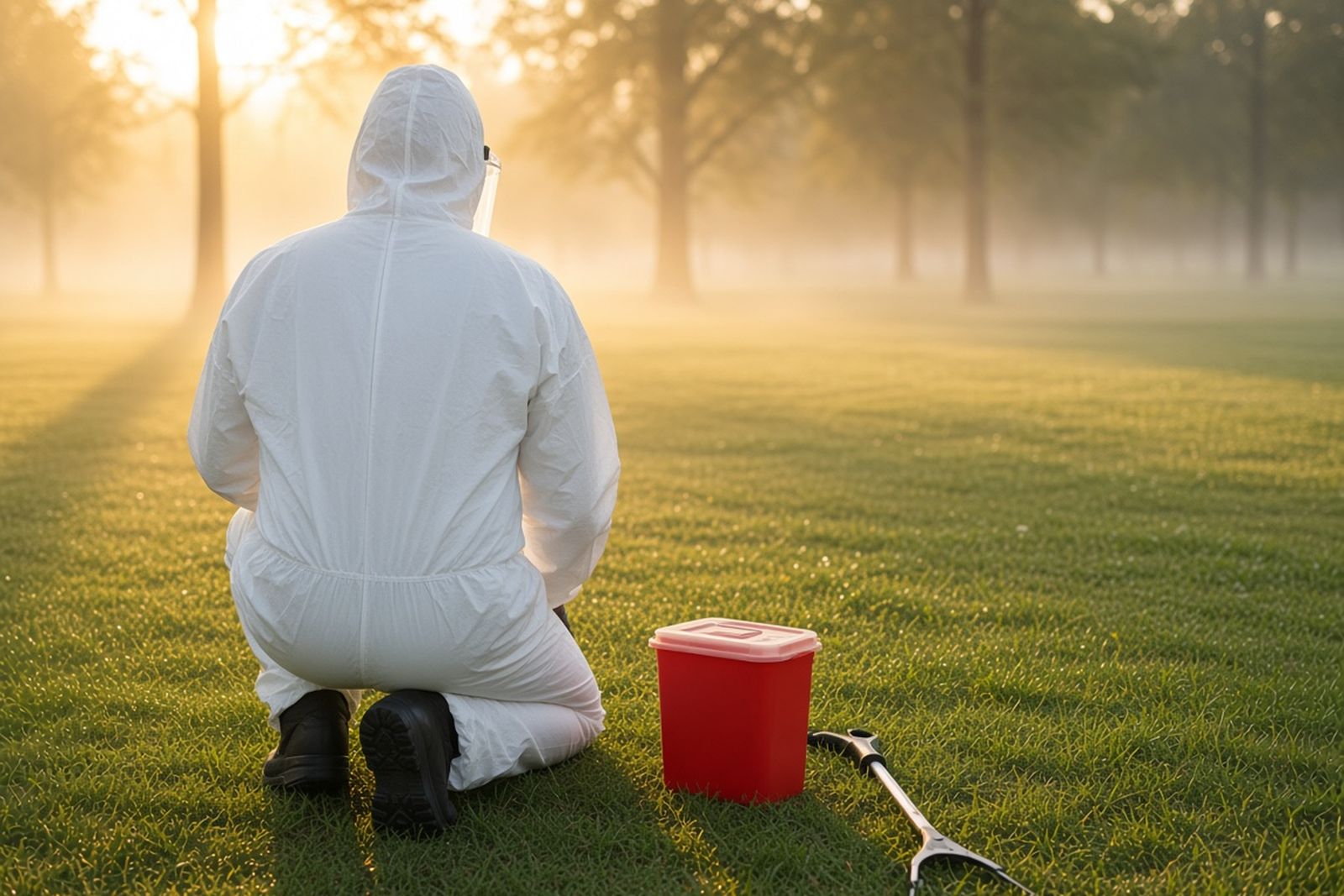
A professional crew now typically walks a defined area in overlapping lanes, uses grabbers and forceps rather than hands, checks predictable collection points such as planters and fence lines, and records every find. Many providers photograph locations or map them, which turns a one-time cleanup into data a property owner can act on.
Tone has changed too. Earlier approaches often framed needle litter purely as a nuisance. Current practice more often treats it as a public health issue connected to addiction and housing, which means crews are expected to work respectfully and, where appropriate, point clients toward community resources.
How the tools evolved
Early field pickups relied on whatever was nearby: a pair of kitchen tongs, a shovel, or a gloved hand. Containers were improvised, and it was common to see a crew carry a single bucket for everything from broken glass to syringes.
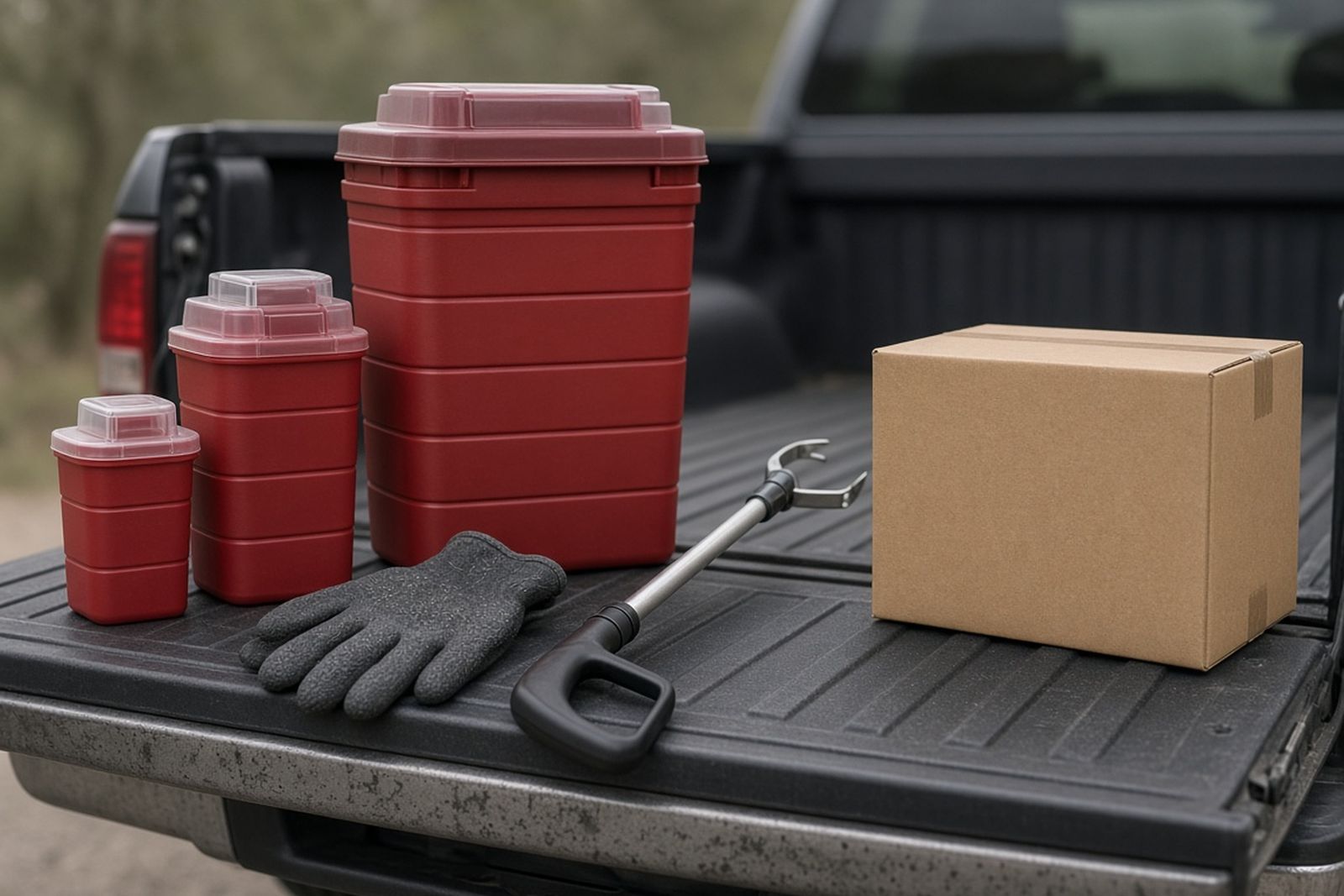
Over time, the kit became more specialized. Long-handled grabbers let technicians reach under bushes and into gaps without bending close. Locking forceps and needle-nose pliers made it possible to extract a needle wedged in wood or pavement with a firm, controlled grip. Portable sharps containers sized to clip onto a belt or cart meant a needle could be secured within seconds of pickup rather than carried across a lot.
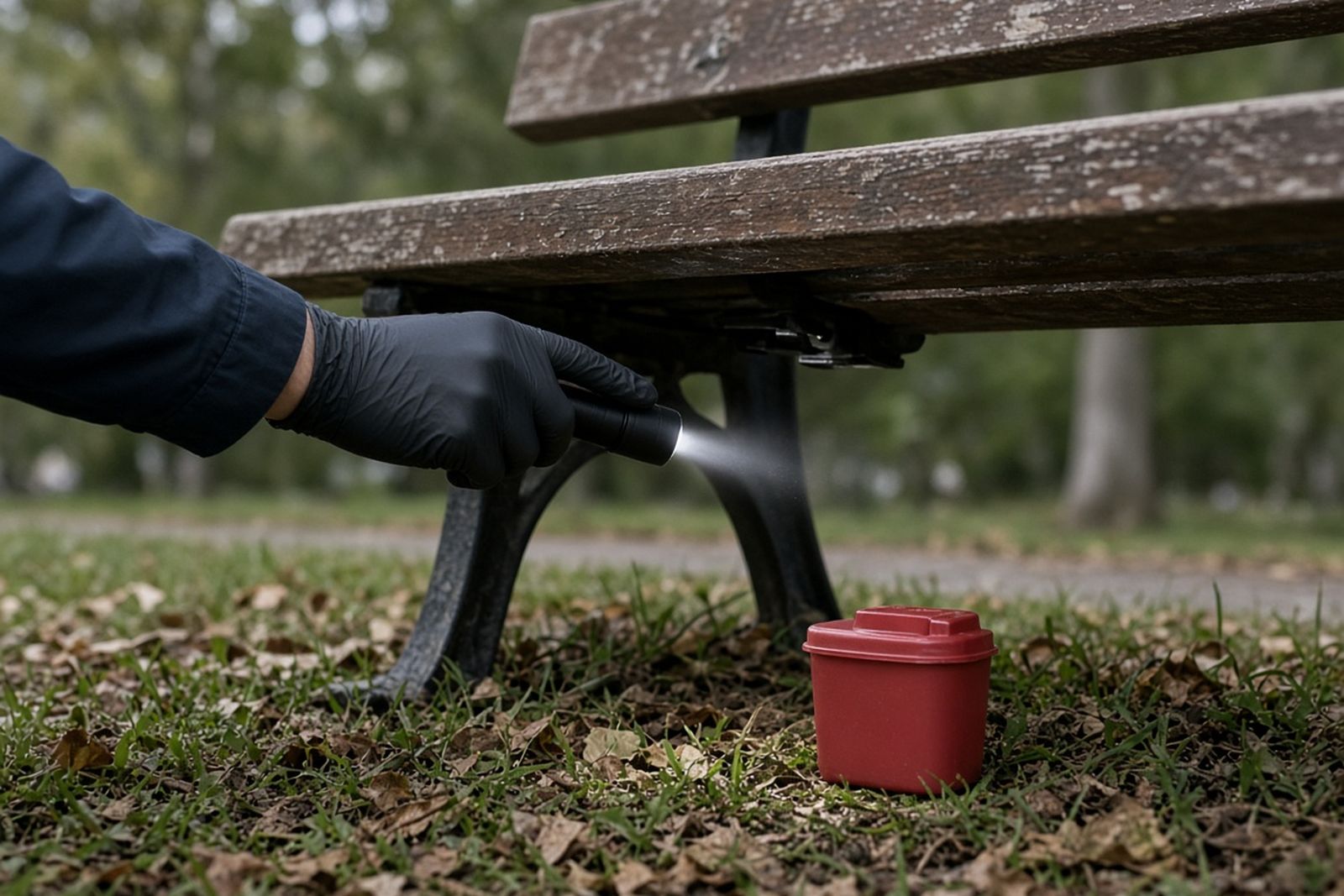
Protective gear improved in parallel. Puncture-resistant gloves, sturdy footwear, and eye protection for sites with blood or other fluids became standard for serious providers. Flashlights and mirrors helped crews check dark stairwells and the undersides of benches.
Record-keeping tools changed the most. Paper checklists gave way to phone photos, timestamps, and simple maps. That shift matters to clients, because a good log now shows not just that a sweep happened, but where the problem is concentrated and whether it is improving.
Then and now: one building across three decades
The downtown office building here is illustrative, a way to see how practice has shifted. In the early years, a janitor who found a needle in the stairwell would sweep it into a dustpan and drop it into the regular trash. No record was kept, and nobody thought about the hauler.
Years later, the same building has a sharps container in the maintenance closet and a written rule that staff use tongs and never recap. The container goes to a licensed medical waste company when full, and the building manager keeps receipts.
In the present-day version, the building contracts a sharps service for weekly sweeps of the stairwell, loading dock, and adjacent alley. Each visit produces a log with counts and locations. After a few months, the logs show most finds near an unlit side door, and the manager adds lighting and a keycard lock. The number of finds drops, and the record shows exactly why.
Where is sharps disposal heading next?
Several trends are likely to keep shaping the field. Home disposal options continue to expand as more medications are given by injection. Cities are experimenting with better data, including mapped needle reports and coordinated sweeps. And prevention, from design changes to public disposal boxes, is getting as much attention as pickup.
For property owners, the lesson from this history is encouraging. Each stage made the work safer and more accountable. When you hire a provider now, you can expect proper containers, trained technicians, a named disposal route, and records you can use, and you should feel comfortable asking for all four.