Short answer
OSHA rules apply to employers and their workers, so they govern how a sharps collection company protects its own technicians rather than certifying your site. The Bloodborne Pathogens Standard is the main one: it shapes exposure control plans, container design, training, hepatitis B vaccination offers, and post-needlestick follow-up. Property owners who assign staff to pick up needles may have duties of their own.
What OSHA does and does not regulate
OSHA's job is worker safety. It sets rules for employers so that the people they send into hazardous situations go home unhurt. It does not license sharps collection companies, inspect your parking lot, or sign off that an area is free of needles.
That distinction matters when you hire help. If a company tells you its work is "OSHA certified," ask what it means. There is no OSHA certificate that says a lawn, stairwell, or alley has been cleared. What exists is a set of obligations the company owes its own employees, and a well-run firm can explain how it meets them.
The picture changes if you are the employer. A property manager who tells a maintenance worker to collect syringes, or a store owner who asks staff to clear the entryway each morning, has created an occupational exposure. At that point, OSHA rules can apply to you as well. A number of states run their own OSHA-approved plans that may add requirements, so if you are in one of those states, check with the state plan's office as well.
The standard that matters most: 29 CFR 1910.1030
The Bloodborne Pathogens Standard, found at 29 CFR 1910.1030, is the rule that does most of the work in this niche. It covers employees who can reasonably be expected to contact blood or other potentially infectious materials as part of their job. A used needle found in a park is exactly that kind of hazard, because you cannot know whose blood may be on it.
The standard is built around a written exposure control plan. That document identifies which jobs involve exposure, describes the methods used to reduce risk, and lays out what happens after an incident. It is meant to be reviewed and updated, not filed away.
Other standards can come into play depending on the job. The general personal protective equipment rules require employers to assess hazards and select gear to match. Hazard communication rules apply to the disinfectants a crew carries. If a site also contains powders or residues that call for respirators, the respiratory protection standard adds its own requirements for medical clearance and fit testing.
What the standard says about containers
Containers are where the regulation gets very concrete. According to OSHA's Bloodborne Pathogens Standard, as published in 2019, workplace sharps containers must be closable, puncture resistant, leakproof on the sides and bottom, labeled or color-coded, and replaced on a routine schedule so they never overfill.
In practice, that rules out the improvised containers people often grab in a hurry. A plastic grocery bag fails immediately. A cardboard box fails as soon as a needle point meets the wall. Even a sturdy bottle can fall short in a workplace setting if it is unlabeled or not easily closed.
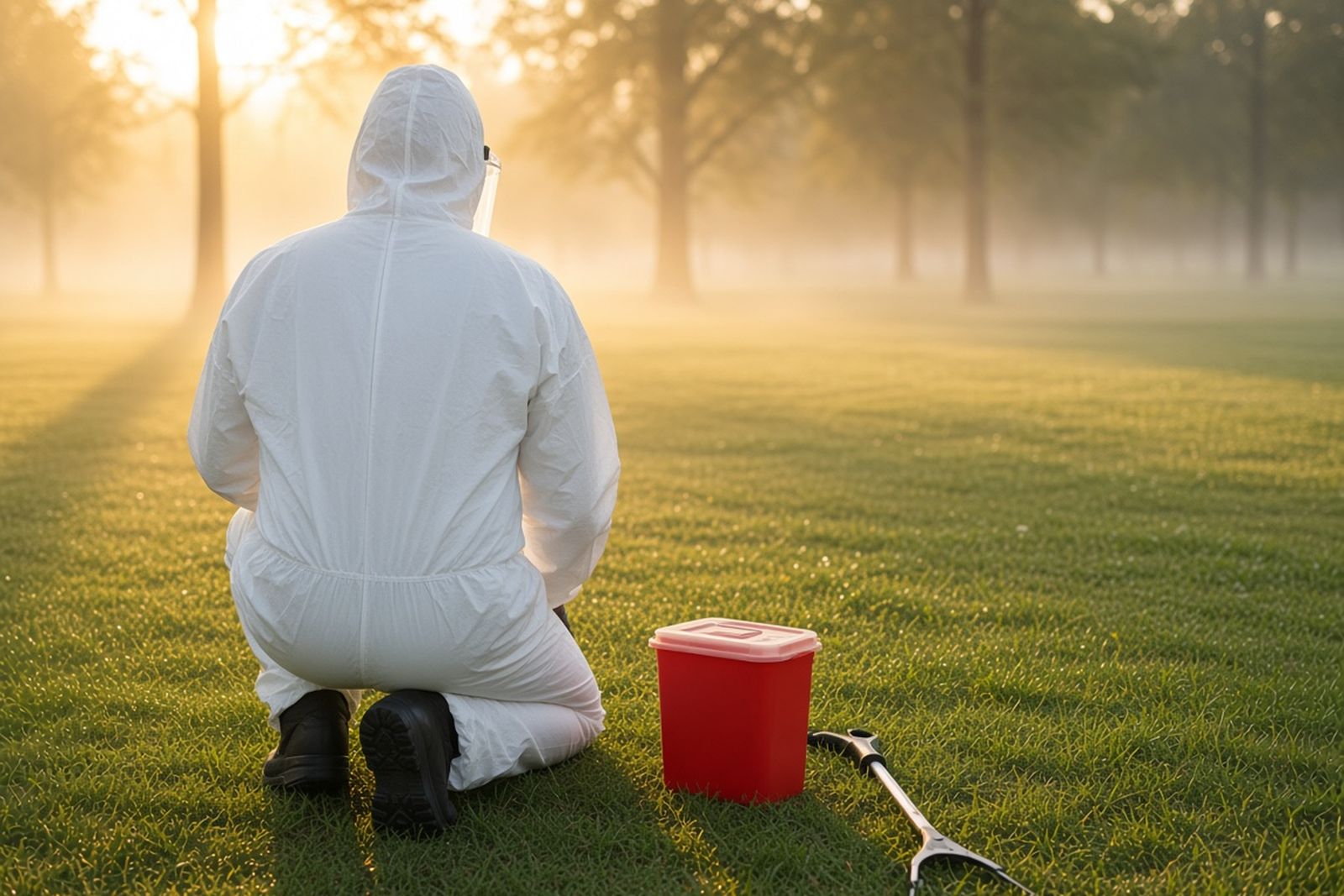
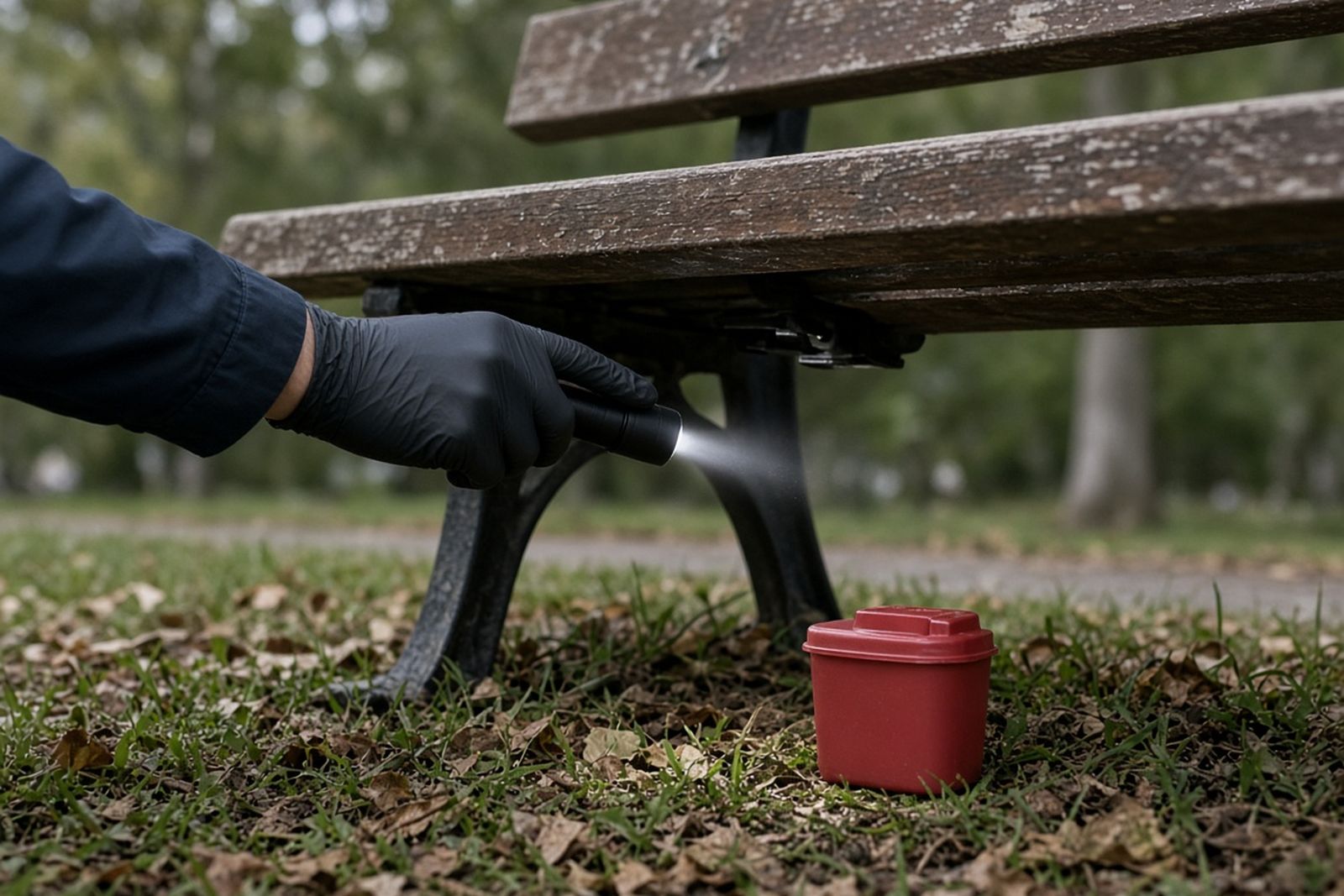
For field crews, the practical translation is simple. Containers ride with the technician, sit upright and stable near the point of pickup, and get sealed before they reach the fill line. A container that is being shaken down or pressed to make room is a sign the routine replacement part of the rule is being ignored.
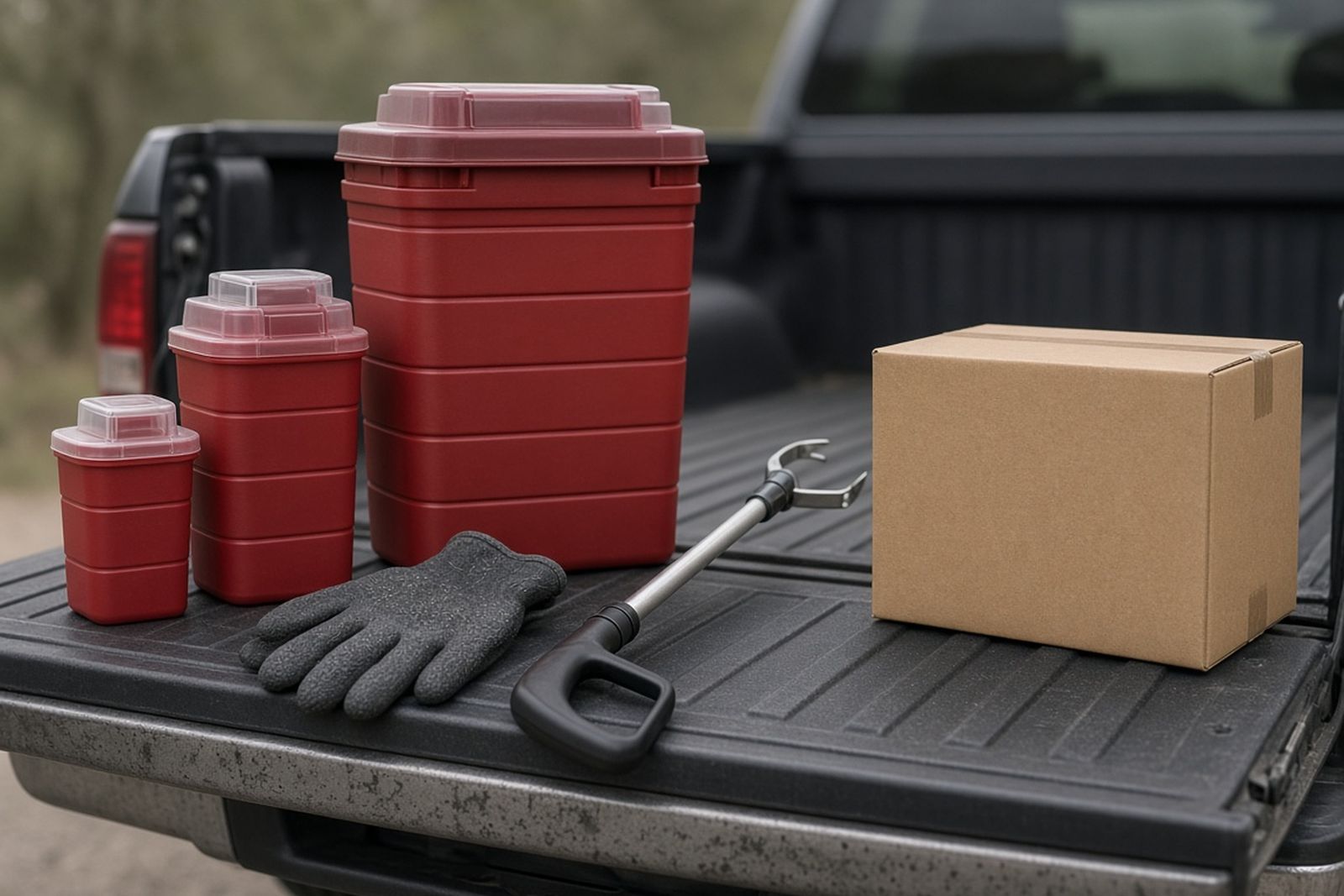
Transport is part of the container story too. A sealed container that tips over in a truck bed, or rides loose next to tools, can crack or open. Good crews secure full containers in a rigid outer bin for the drive, keep them separate from clean supplies, and hand them off to a licensed medical waste route rather than a dumpster.
Training and vaccination
Employers covered by the standard must train workers before they are assigned exposure tasks and repeat that training regularly. The training should explain how bloodborne diseases spread, how the company's exposure control plan works, how to use the tools and PPE provided, and what to do immediately after a stick.
Employers must also offer the hepatitis B vaccine series at no cost to employees with occupational exposure. Workers can decline, but the offer has to be made and documented. For a sharps technician who will handle thousands of needles over a career, that vaccine is one of the most important protections available.
When you interview a provider, ask how often its technicians are retrained and whether new hires shadow an experienced crew before handling sharps alone. A thoughtful answer suggests the company treats training as a working tool rather than a box to check.
- Initial training before any exposure task is assigned.
- Refresher training on a regular schedule and whenever procedures change.
- A documented hepatitis B vaccination offer.
- Access to the written exposure control plan.
- Clear steps for reporting and follow-up after a stick.
What happens under OSHA rules if a technician gets stuck?
The standard requires employers to provide a confidential medical evaluation and follow-up after an exposure incident. That includes documenting how the stick happened, testing where appropriate, counseling, and access to preventive treatment when a clinician recommends it.
Needlesticks are far from rare in healthcare, which gives a sense of how easily they happen even among trained people. The CDC estimated in 2024 that about 385,000 needlestick and other sharps-related injuries occur each year among hospital-based healthcare personnel in the United States. Field technicians work without the controlled lighting, clean trays, and safety-engineered devices a hospital has, so their procedures need to be even more deliberate.
Underreporting is a real concern. The CDC's NIOSH Stop Sticks campaign reported in 2019 that about half or more of sharps injuries go unreported. A company that makes reporting easy and free of blame is more likely to catch problems early and protect its workers.
Employers also have recordkeeping duties. Certain sharps injuries must be logged, and OSHA expects a sharps injury log to be kept in a way that protects the injured worker's privacy. You will not see those records as a customer, but asking whether the company keeps them is a fair question.
When your own staff pick up needles
Many businesses drift into sharps collection without planning to. A janitor finds a syringe in a restroom, a groundskeeper spots one in a planter, and soon it is part of the morning routine. If this sounds familiar, take a close look at your own obligations.
Once collecting sharps is a reasonably expected part of someone's job, the employer may need an exposure control plan, proper containers, training, PPE, and a vaccination offer for that worker. A pair of garden gloves and a coffee can is not a plan.
You have two realistic options. You can build a compliant in-house program with written procedures, tools, and disposal arrangements. Or you can adopt a simple no-touch rule for staff, where they mark and guard the spot and call a trained provider. Either choice is defensible. Letting untrained employees handle needles informally is the one that tends to create problems.
If you choose the in-house route, put the essentials in writing: who is designated to respond, where containers are kept, how full containers leave the building, and who staff call after a stick. Review the plan once a year and whenever the pattern of finds changes, such as a new hot spot near a loading dock or a sudden increase after a nearby service closes.
Six questions about a provider's OSHA compliance
You do not need to become an expert in federal worker safety law to hire well. A few direct questions will reveal whether a company understands its obligations and takes them seriously.
Listen for specifics. A provider who can describe its exposure control plan in plain language, name the containers it uses, and explain its post-stick protocol is usually the kind of company that also documents your job carefully.
Finally, pay attention to how a company talks about its own people. Providers that brush off questions about worker protection often cut corners elsewhere, including in how thoroughly they search and where the collected sharps end up.
- Do you have a written exposure control plan, and when was it last reviewed?
- What sharps containers do your technicians carry, and when are they replaced?
- How are new technicians trained before they handle needles alone?
- Do you offer hepatitis B vaccination to every technician?
- What happens, step by step, if one of your crew is stuck on my property?
- Do any state-plan or local rules add to the federal requirements where I am?