Short answer
Residential sharps disposal usually concerns needles and lancets a household uses for its own medical care, handled through drop-off sites, mail-back kits or local programs. Commercial sharps work covers discarded syringes found on business property and sharps generated by businesses, which brings employer safety duties, regulated waste handling and documentation. Disposal rules for both are set largely at the state level.
Residential sharps: what the term covers
Residential sharps are the needles, syringes, lancets and auto-injectors people use at home to manage their own health or a family member's. Insulin pens, fertility medications, blood thinners, allergy injectors and home dialysis supplies all generate them.
These sharps come from a known user and are usually handled by that user. The job is less about cleanup and more about getting used sharps into a sturdy container and then into an approved disposal route. The scale is large. According to a 2024 summary of state laws from the Legislative Analysis and Public Policy Association, an estimated nine million US sharps users give more than three billion injections outside healthcare facilities each year, and there are no federal requirements for disposing of home-generated sharps.
Residential sharps also include the less common situation of a homeowner finding a discarded needle in the yard, a rental unit being turned over after a tenant leaves syringes behind, or a family clearing out a relative's home. Those cases look more like commercial cleanup, even though they happen at a house.
Rental housing sits in between. A single-family rental is a home, but the owner is running a business, and the maintenance worker who turns the unit over may be an employee or contractor with exposure. Landlords who find syringes during turnover often do best by following the commercial playbook: no-touch for untrained workers, a trained provider for collection, and records kept with the unit file.
Commercial sharps: two different groups
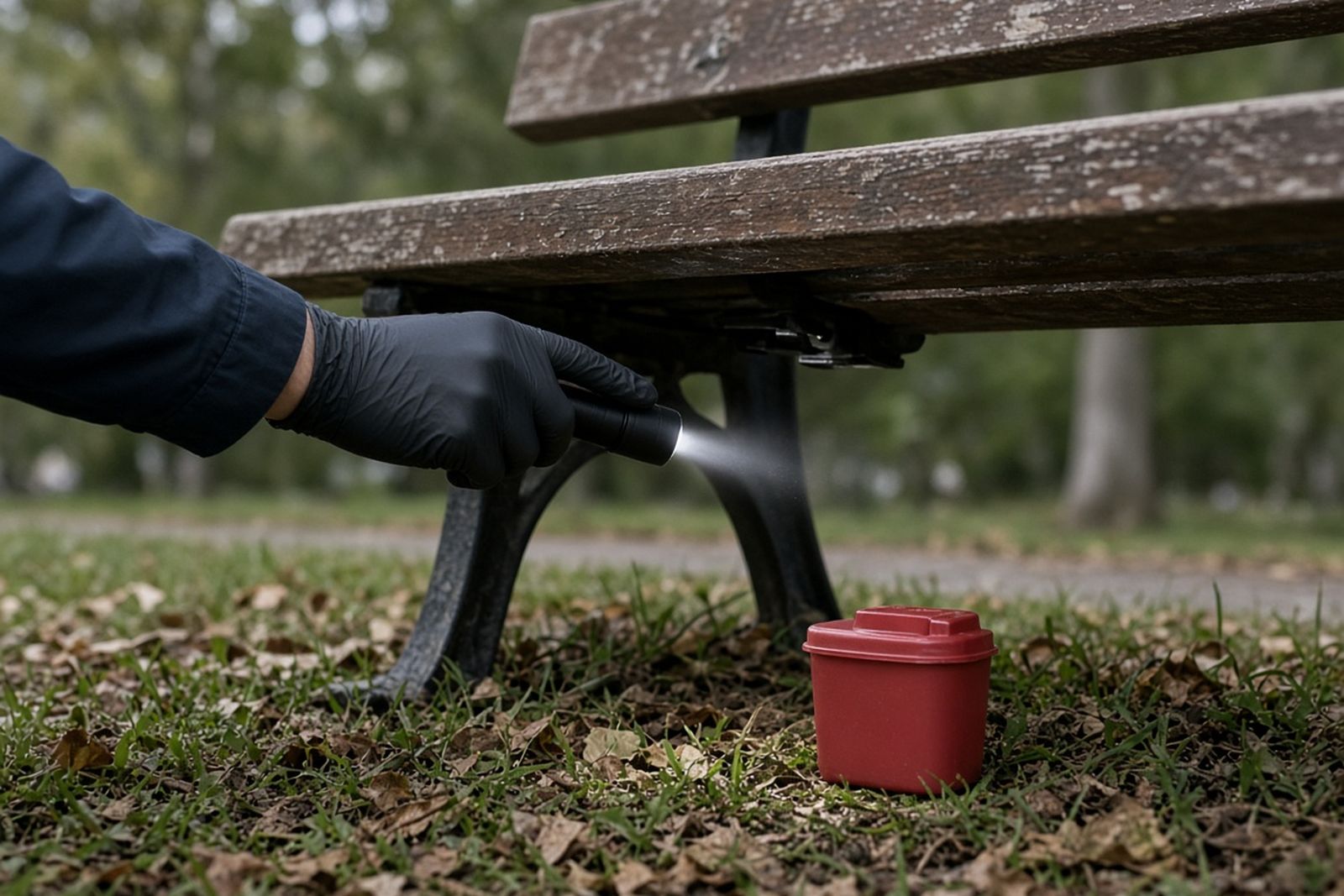
Commercial sharps work falls into two broad groups. The first is discarded sharps found on business property: syringes in a restaurant restroom, a hotel room, a retail parking lot, an office stairwell or a warehouse loading dock. The source is unknown, so the needle is treated as a potential bloodborne hazard.
The second is sharps that a business generates as part of its operations, such as a clinic, pharmacy, tattoo studio, veterinary office, school nurse's office or workplace first-aid program. Those generators typically fall under state medical waste rules and need a contracted waste service rather than a household option.
In both groups, employees may be exposed as part of their jobs. That is the key difference from most residential situations: a business has worker-safety obligations, and it usually has more formal waste handling duties as well.
Disposal routes, and where loose sharps end up
Households often have several options, depending on where they live. Some areas offer free drop-off at pharmacies, hospitals, fire stations or household hazardous waste sites. Mail-back programs let people ship a filled container to a treatment facility. A few communities still allow sealed containers in household trash, while others prohibit it.
Those rules can be strict, and a route that is routine in one state may be banned in the next. Not every household option accepts every sharp, either. Some household hazardous waste events turn sharps away, so check before you drive a container across town.
Businesses generally cannot use household options. Sharps collected on commercial property, or generated by a business, typically go through a regulated medical waste hauler or a mail-back service designed for commercial users, with paperwork that tracks the waste to treatment. Your state environmental or health agency decides which of these routes are allowed where you are.
Loose sharps tossed into household or commercial trash do not disappear. They travel to people who sort and handle waste. An EREF and SWANA survey reported in 2018 found needlestick injuries among recycling sorting-line workers at 3.9 per 100 full-time employees in 2016, and 56 percent of facilities reported at least one worker stuck.
For households, the lesson is to keep sharps out of the recycling bin entirely and to follow local rules for sealed containers. For businesses, it means making sure janitorial crews know never to compress trash bags by hand, never to reach into bins, and to report bags that feel like they contain sharp objects.
Which worker-safety rules apply to each?
At home, a person managing their own injections is not an employee, so federal workplace rules do not reach them. Their protection comes from good habits and a proper container.
Businesses are different. If an employee can reasonably be expected to contact a used needle as part of the job, such as a custodian who empties restroom bins or a groundskeeper who clears planters, the employer may need to meet the OSHA Bloodborne Pathogens Standard. That can mean an exposure control plan, training, appropriate containers and protective equipment, a hepatitis B vaccination offer and a post-exposure procedure.
Many businesses sidestep those duties by adopting a no-touch rule for regular staff and calling a trained provider for every find. Others train a designated responder. Either approach can work, but doing nothing formal while employees routinely pick up syringes is the arrangement most likely to lead to an injury.
Why commercial sweeps run larger
A household sharps problem is often contained: a single container that needs a disposal route, or one needle in a flower bed. Commercial properties, by contrast, have more ground, more public access and more places to hide something.
Commercial sites also tend to have recurring problems. A restroom or loading dock that produced a syringe last week may produce another next week. That pushes businesses toward standing arrangements, fixed disposal containers in restrooms and regular sweeps rather than one-time pickups.
Documentation expectations differ as well. A homeowner rarely needs more than a note of where the container went. A business may need visit reports for its landlord, its insurer, its corporate safety team or a franchise inspection, along with manifests or receipts showing the waste reached a licensed facility. Asking for those records up front is much easier than trying to reconstruct them after a complaint.
- Larger search areas, including parking structures, landscaping and roofs.
- Public restrooms with drop ceilings, tank lids and dispensers to check.
- Waste streams, such as trash compactors and recycling, where hidden sharps injure workers downstream.
- Multiple stakeholders, including tenants, landlords, security contractors and janitorial vendors.
Two calls on one afternoon: a house and a strip mall
The pair of calls below is an illustrative comparison, not a record of real jobs. Both come in on the same afternoon. In the first, a homeowner finds a single capped syringe in her front hedge near a sidewalk. In the second, a strip mall property manager reports several syringes behind the building near the dumpster enclosure.
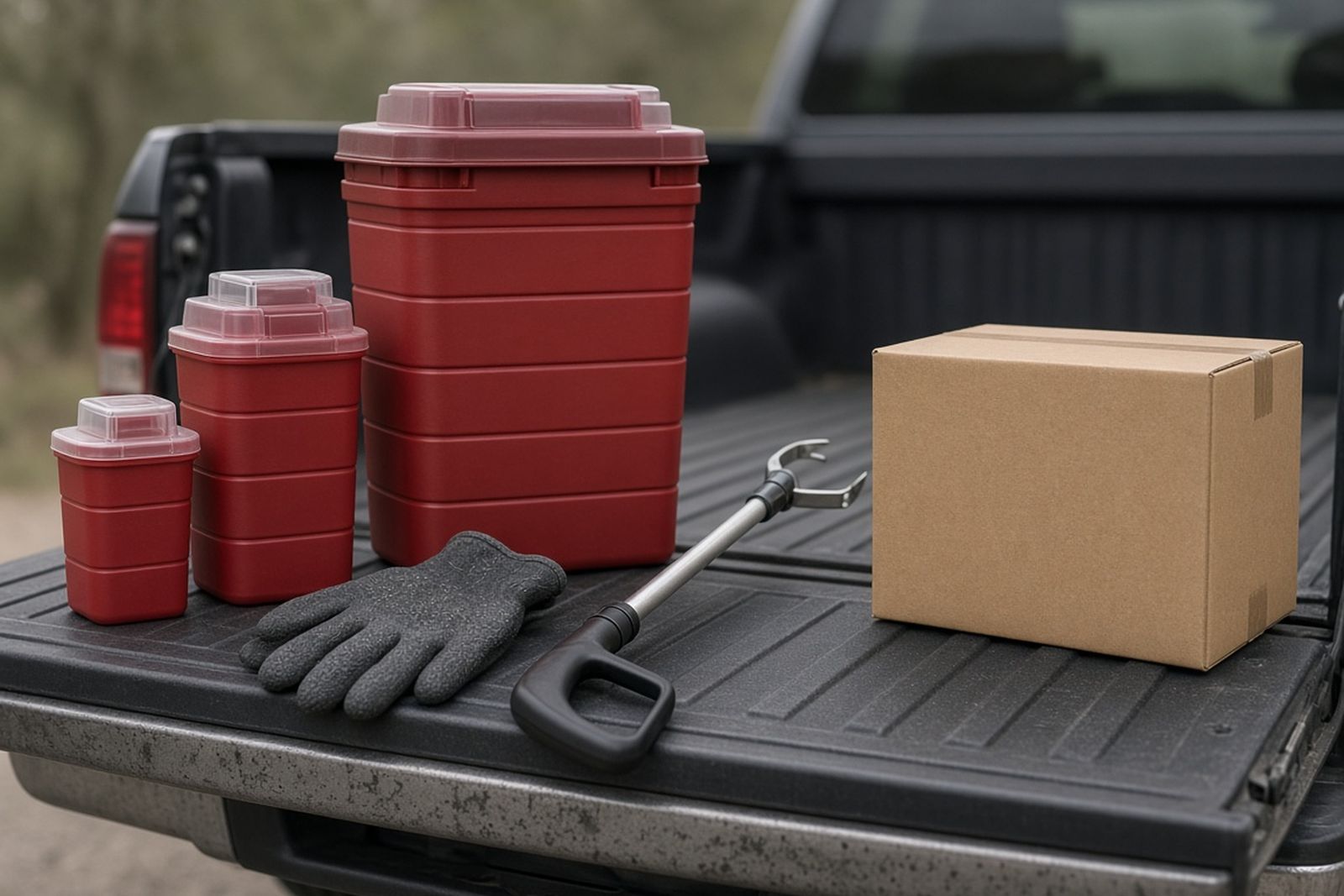
The homeowner learns that her city runs a sharps pickup service and that a local pharmacy accepts sealed containers. She keeps her children and dog inside, uses long tongs and a thick plastic bottle with a screw cap, and drops the sealed container at the pharmacy the next day. If she had not felt comfortable doing that, calling a provider would have been a reasonable choice.
The strip mall manager has more to think about. The janitorial vendor's staff empty the dumpsters, the tenants' employees take out trash, and the lot is open to the public at night. The manager books a sharps provider to sweep the rear of the building, asks the janitorial vendor to confirm its crew's no-touch rule, and requests a report listing what was found and where it went for disposal. After a second find the following month, the manager asks the owner to fund better lighting and a locked enclosure gate.
Questions for a provider, by setting
The questions shift with the setting. For a residential job, focus on what you need picked up, where it will go and whether you can use a local program instead. For a commercial job, focus on scope, documentation and your own staff's role.
Whatever the setting, avoid anyone who suggests that sharps can go into a regular dumpster or that a quick visual pass is enough for a large property.
- Residential: Can I use a pharmacy, drop-off or mail-back program for this?
- Residential: If you collect it, which disposal route will you use?
- Commercial: What areas will you search, and how will you document them?
- Commercial: What should my staff do between your visits?
- Commercial: Can you provide fixed disposal containers for restrooms, and who services them?
- Both: What happens if someone has already been stuck?
What if someone is stuck, at home or at work?
The first steps are the same everywhere. Wash the area with soap and running water, do not squeeze or scrub the wound aggressively, and seek medical evaluation promptly. A clinician will decide what testing or preventive treatment is appropriate.
At work, the injured person should also report the injury to a supervisor right away so the employer can start its post-exposure process and record the incident. At home, it helps to write down when and where the stick happened and what the needle looked like, without trying to retrieve or test the needle yourself.