Short answer
Environmental responsibility in sharps disposal means keeping needles out of recycling streams, storm drains, parks and loose trash, containing them in rigid closed containers, and sending them to a licensed treatment route that renders them noninfectious and unrecognizable. It also means choosing sensible container and transport practices and supporting community disposal options that stop needles from being discarded in the first place.
More than a safety issue
A discarded syringe is a safety hazard to the next person who touches it. It is also a small piece of plastic and metal that can travel a long way from where it was dropped. Rain washes needles from gutters into storm drains, and many storm systems empty straight into creeks, rivers and bays without treatment. Needles turn up on beaches, riverbanks and in the gravel of drainage channels.
Loose sharps in regular trash create a different set of problems. They ride through garbage trucks, transfer stations and sorting facilities, where workers handle waste by hand. They can end up in compost or recycling streams where they contaminate material and injure staff.
Thinking environmentally means following the needle all the way to its end point. The goal is a clear, contained path from the moment it is picked up to the moment it is treated and destroyed.
There is also a social side to environmental responsibility. Parks, playgrounds and beaches that repeatedly turn up needles lose their value to the neighborhood. Families stop using them, volunteers stop cleaning them, and the problem gets worse because fewer people are around to notice and report it. Consistent, well-documented collection helps give those spaces back.
Who regulates where collected needles end up?
Many people assume a single federal agency sets the rules for medical waste. That has not been the case for decades. According to EPA's 2024 guidance on medical waste, regulation now rests primarily with state environmental and health departments rather than with a federal program.
As a result, what counts as regulated medical waste, how it must be packaged, who can haul it and how it must be treated all depend on your state. Local governments and waste haulers may add their own rules about what they will accept. Transport of sharps on public roads can also fall under federal hazardous materials shipping rules in some situations.
A responsible provider should be able to tell you which state program governs its work and where your waste will be treated.
Inside the treatment facility
Collected sharps typically go to a facility permitted to treat medical waste. The treatment is designed to do two things: make the waste noninfectious and make the sharps unrecognizable and unable to cause injury.
Common approaches include steam sterilization in an autoclave followed by shredding or grinding, and high-temperature incineration. Some facilities use other permitted technologies. After treatment, the residue may be managed as ordinary solid waste, depending on state rules.
Each method has environmental tradeoffs, such as energy use, air emissions and the volume of residue sent to landfill. You probably will not choose the treatment method yourself, but you can ask your provider which facility it uses, and a transparent company will tell you.
Home needle-clipping devices and similar gadgets are sometimes marketed as a greener choice because they reduce the volume of sharp waste. They can help some households, but the clipped needles and the used syringes still need proper disposal. Check local rules before relying on any device that promises to make sharps safe for the trash.
Why must needles stay out of the recycling bin?
It can be tempting to toss a plastic sharps container or a detergent bottle full of needles into recycling because the container looks recyclable. It is not. Recycling facilities rely on workers and machines to sort material, and a single needle-filled bottle can burst open on a conveyor.
Sorting-line workers are hurt by sharps that reach recycling, and every bale contaminated with medical waste is harder to sell. The container, however sturdy, has become medical waste the moment it holds a used needle.
The same logic applies to compost and yard waste bins. Needles hidden in leaves or grass clippings do not break down and can injure workers at composting sites.
- Never put sharps or sharps containers in recycling, even if sealed.
- Never put loose needles in household trash.
- Never flush needles or drop them into storm drains.
- Keep sharps out of yard waste and compost bins.
Containers, packaging and the footprint they leave
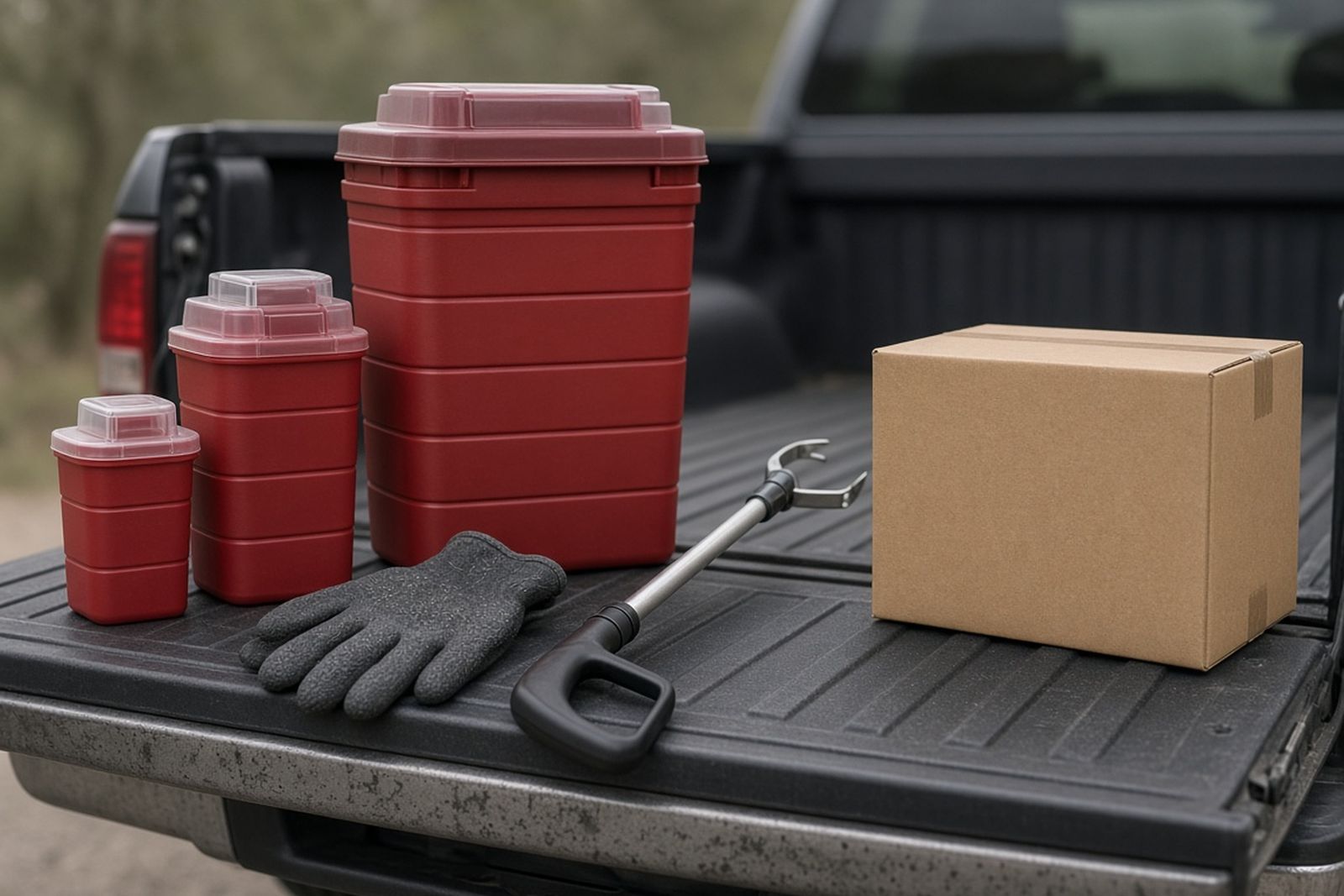
Containers matter for safety first, but they also shape how much material ends up treated. Single-use plastic sharps containers are common, and for many households and small sites they are the practical choice.
Some commercial generators use reusable sharps container programs, in which a service provider collects filled containers, empties and cleans them at a permitted facility, and returns them. These programs can reduce plastic waste for higher-volume generators. They depend on a local service offering them and on strict handling to keep them safe.
Filling containers sensibly also helps. A container that goes for treatment one-quarter full wastes plastic and treatment capacity, while one packed past its fill line creates injury risk. Following the container maker's fill line, and not pressing contents down, balances both concerns.
Community disposal programs: prevention upstream
The most effective environmental step is often preventing needles from being discarded outdoors to begin with. Public disposal kiosks, pharmacy take-back, mail-back programs and syringe services programs give people a safe place to put used sharps.
Research supports this. A 2019 study by Levine and colleagues reported that discarded syringes found on walkthroughs declined 49% after a syringe services programme was implemented in the study area. That is fewer needles in parks, gutters and storm drains for anyone to find.
Large cities show how much material a public program can pull out of the environment. Seattle Public Utilities reported in 2025 that it collected more than 800,000 needles, syringes and lancets from public spaces in 2024, and over 2 million from 2022 through 2024. Every one of those represents a sharp that did not wash into a waterway.
What does responsible practice look like for a sharps collection company?
Environmental care in this field is mostly about discipline. A responsible provider does not cut corners with disposal to save a trip, and it can show where every container went.
Ask how the company handles sharps it finds in water, such as a creek bank or drainage channel. Those areas may need coordination with the local stormwater or parks agency, and the crew should avoid disturbing sediment or vegetation more than necessary.
- Uses rigid, closable, labeled containers and never overfills them.
- Keeps full containers secured during transport so they cannot tip or crack.
- Delivers waste only to licensed haulers or permitted treatment facilities.
- Provides records that track waste from your site to treatment.
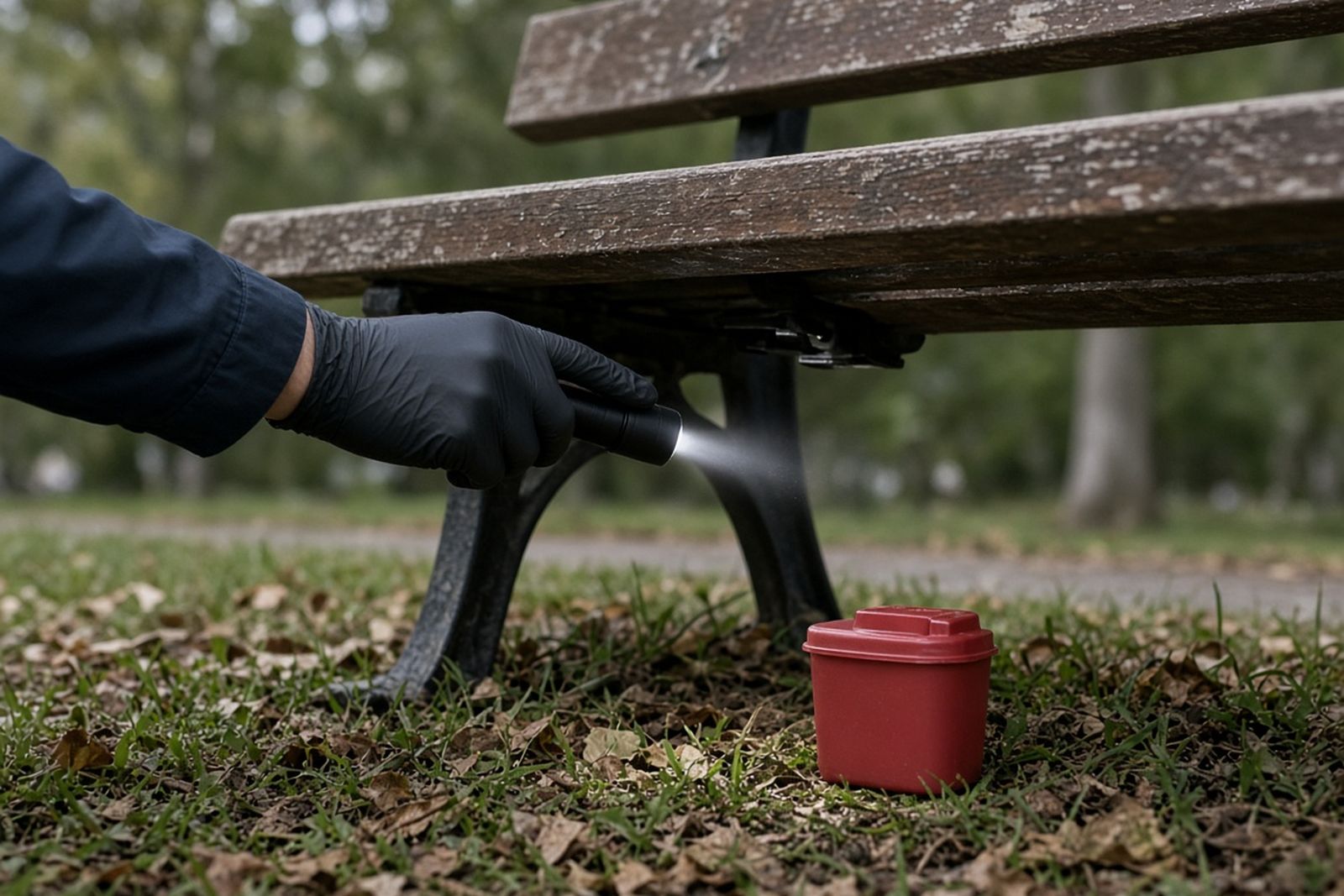
- Checks storm drain inlets, gutters and waterside areas during outdoor sweeps.
- Leaves no containers, gloves or supplies behind on site.
Case sketch: a creekside trail after a spring thaw
This sketch is illustrative; the town and trail are composites. A small town parks department notices syringes along a creekside trail each spring as snow melts. Some are caught in brush near the water line; others lie in a culvert that drains a nearby parking lot.
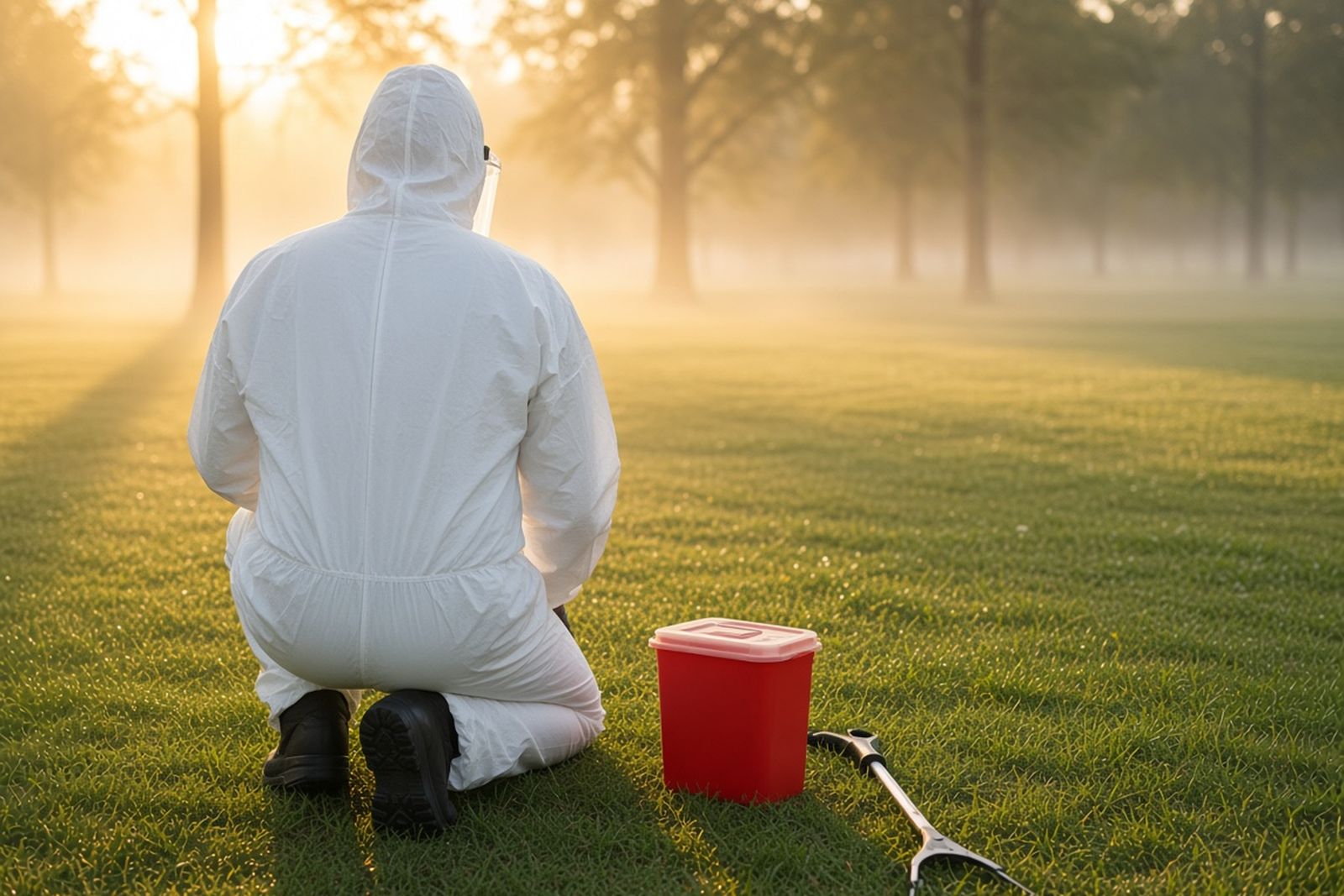
The department books a sharps provider for a coordinated sweep. The crew walks the trail and banks in overlapping passes, uses long tongs to lift items from brush without trampling the bank, and photographs the culvert mouth before retrieving what is visible from the edge. They leave the culvert interior to the public works team, who have confined-space procedures.
The provider seals the containers at the end of each section of trail and logs the count. The department receives a report showing clusters near the parking lot drain. That leads the town to install a public disposal kiosk near the lot and to add a storm drain inlet screen. The following spring, the crew finds fewer items along the water, and the department keeps both years' reports together.
What can I do as a household or property owner?
Your part is smaller than a treatment plant's but still meaningful. Every sharp that goes into a proper container and a proper disposal route is one less needle in the waste stream or the watershed.
If you find needles outdoors, especially near water, do not kick them into a drain or bury them. Mark the spot, keep people and pets away, and contact your local sharps program or a trained provider.
Property owners with recurring outdoor finds can also look upstream. Better lighting, trimmed vegetation, a public kiosk nearby or a conversation with the local syringe services program may reduce what ends up on the ground. Those steps protect both people and the watershed, and they usually cost less over time than repeated sweeps of the same ground.
- Use a rigid, puncture-resistant container with a secure lid for home sharps.
- Find out whether your area offers drop-off, kiosk or mail-back options.
- Ask any provider you hire where your waste will be treated.
- Report needles near storm drains or waterways to the local agency responsible.