Short answer
Before needle and sharps disposal work begins, assess ten risks: sharps hidden in ground cover or debris, recapping and manipulation, overfilled containers, inadequate packaging, blood exposure, bystanders and children, lighting, weather and terrain, mixed debris or human waste, personal security at the site, and transport and downstream disposal. Planning for each one keeps hands away from needle points and protects everyone who handles the waste later.
Why every sharps job starts with a risk check
Needle pickups can look routine. A report comes in, someone goes out with tongs and a container, and the needles are gone. But most accidental sticks happen during exactly this kind of routine work, when a technician is moving quickly, reaching into places they cannot fully see, or dealing with a container that is fuller than it should be.
A short risk check before work starts slows things down just enough. It helps the crew decide how large the search area should be, which tools and containers to bring, what protective gear is needed, and whether the site calls for extra people or coordination.
The ten risks below apply to most found-needle work, from a single stairwell to a large vacant lot. Property managers and business owners can use the same list to understand a provider's plan.
The check does not need to be long or formal. For a small site, it may be a few minutes of walking the area and talking through each risk. For a large or complicated site, it may mean a written plan shared with the property owner. What matters is that it happens before anyone reaches for a needle.
- 1. Sharps hidden in ground cover or debris
- 2. Recapping, bending, or breaking needles
- 3. Overfilled containers
- 4. Inadequate packaging
- 5. Blood exposure and worker vaccination
- 6. Bystanders, children, and pets
- 7. Lighting, weather, and terrain
- 8. Mixed debris and human waste
- 9. Personal security on site
- 10. Transport and downstream disposal
Risks 1 and 2: hidden sharps and hand manipulation
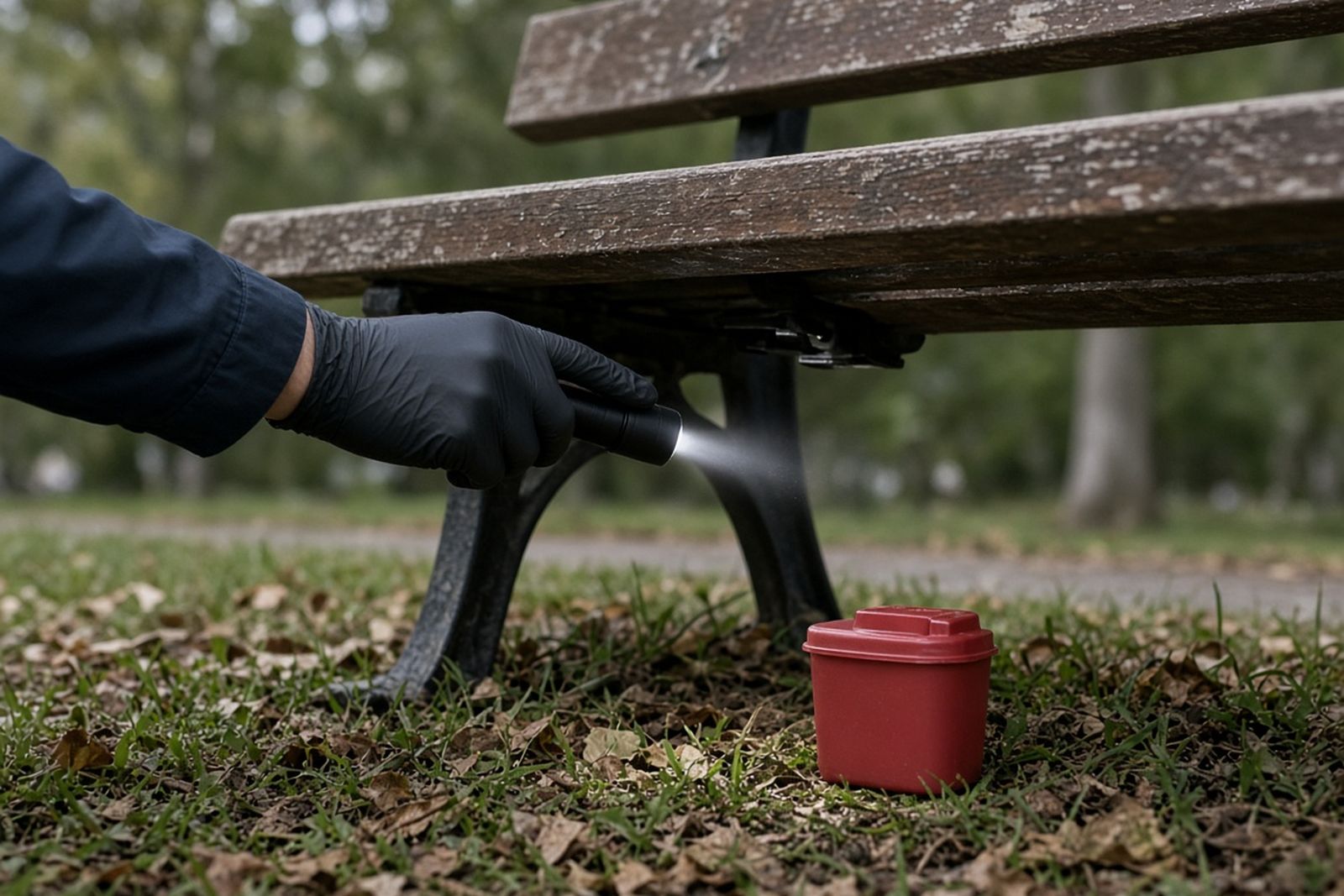
Hidden sharps are the first and largest risk. Needles slip into mulch, gravel, leaf litter, and tall grass. They wedge into cracks in pavement, fall into storm drains, and get tucked under stairs, inside planters, and among bags and blankets. Indoors, they hide in mattresses, cushions, drawers, pockets, vents, and ceiling tiles.
The control is a slow, deliberate search. Technicians look before they reach, part vegetation with tools rather than hands, rake ground cover in shallow layers, and use lighting for shadows. They never reach blindly into a bag or pile.
The second risk is manipulation. Recapping a needle, bending it, breaking it, or trying to separate it from a syringe all bring the point toward fingers. The safe practice is simple: pick up each sharp as found with a no-touch tool and drop it point-first into a container. Capped needles are treated exactly like uncapped ones.
Risk 3: overfilled containers
Overfilled containers are a leading cause of sticks. When a container is packed past its fill line, a needle dropped in can bounce back out, and needles already inside may poke through the opening. Pressing contents down to make room is especially dangerous.
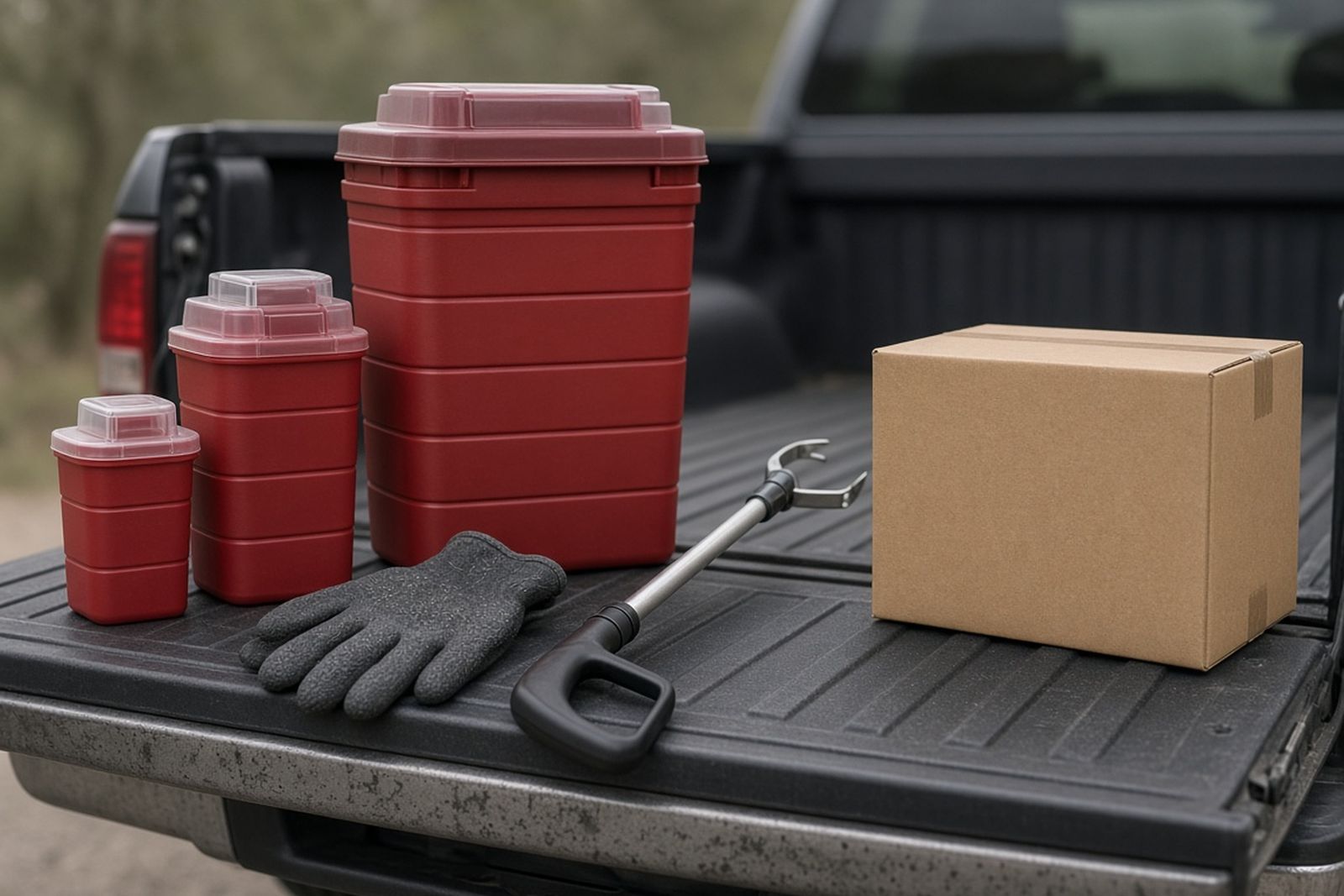
The fix is to bring more containers than you think you will need and swap early. Mark or check the fill line and stop there.
Risk 4: inadequate packaging
The fourth risk is inadequate packaging. Thin plastic bags tear, soft bottles can be pierced, and cardboard boxes get wet and fail. Sharps belong in rigid, puncture-resistant containers with lids that lock. Those containers should be closed and secured before they are moved, and they should ride upright and separate from clean supplies.
- Bring extra containers in several sizes.
- Stop at the fill line; never press contents down.
- Use only rigid, lockable, puncture-resistant containers.
- Secure containers upright for transport.
Risk 5: blood exposure and worker vaccination
Any found needle may carry blood, even if none is visible. Hepatitis B is a particular concern for workers who have not been vaccinated against it.
That is why hepatitis B vaccination is so important for anyone who collects sharps regularly. Before work begins, a provider should be able to confirm that workers have been offered vaccination and trained under a written exposure plan.
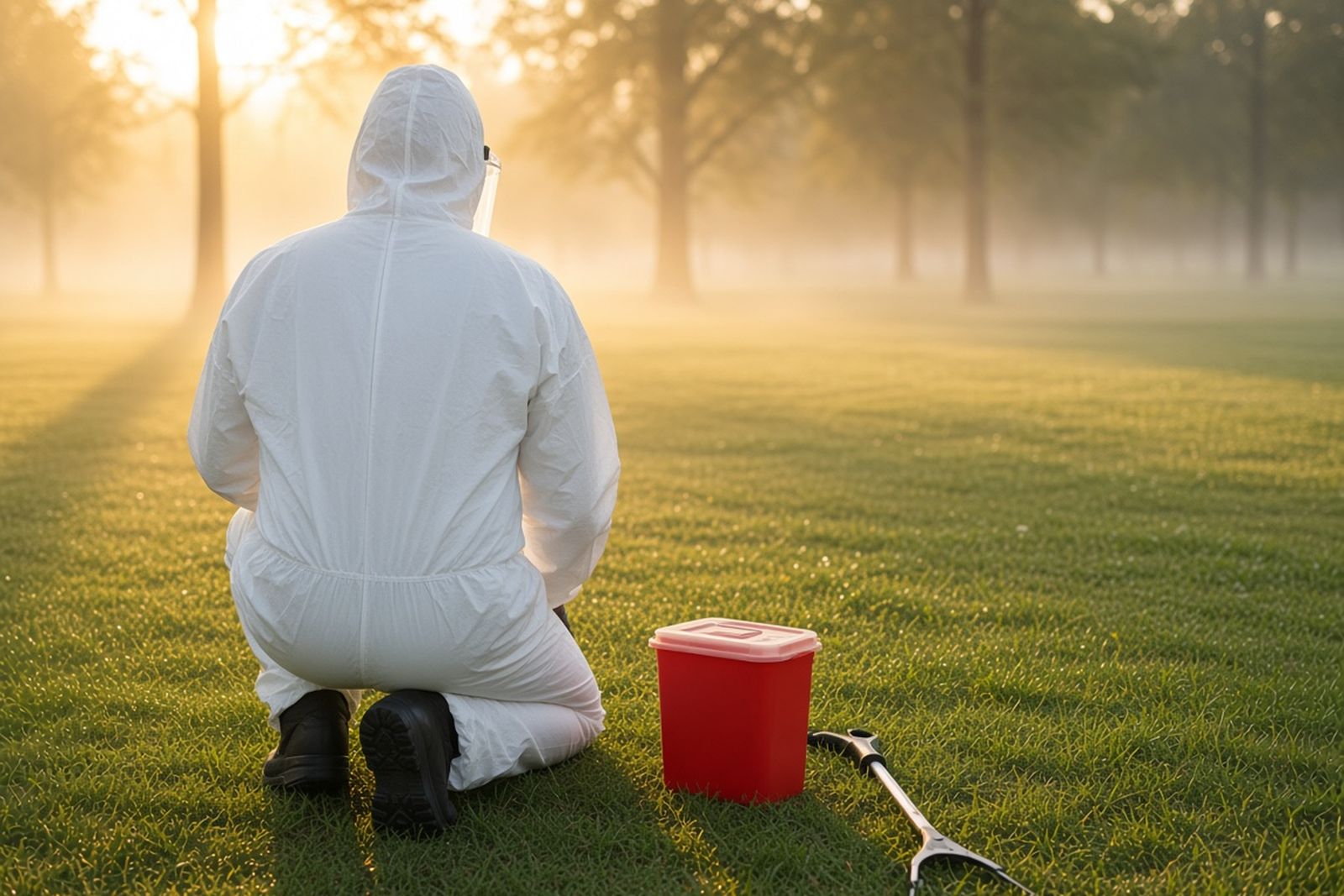
Protective gear adds a layer: layered gloves, eye protection where fluid might splash, and puncture-resistant footwear. None of it is needle-proof, so it supports safe technique rather than replacing it.
Every crew should also know the first-aid steps after a stick: let the wound bleed, wash with soap and water, report immediately, and seek medical evaluation the same day.
Risk 6: bystanders, children and pets
Public and shared spaces are rarely empty. Children, pets, customers, tenants, and passersby may wander into the search area. Children are especially at risk because they may pick up a needle out of curiosity.
Before starting, set clear boundaries with cones, tape, or signage, and close off indoor areas where possible. Ask property staff to route people away. Keep containers closed and out of reach whenever they are not actively in use.
If the site is a playground, school, or park, coordinate with the operator to schedule work when the fewest people are present, and do a final sweep before reopening the area.
Staff are bystanders too. Janitors, landscapers, and maintenance workers often find needles first and may be tempted to pick them up to be helpful. Give them a clear rule that they should never handle a needle, even with gloves, and should instead mark the spot from a distance and report it.
Risk 7: lighting, weather and terrain
Lighting, weather, and terrain affect how well technicians can find needles and how safely they can move. A syringe in shadow under a bush is easy to miss even in daylight. Rain makes surfaces slick and can wash needles into drains. Snow can hide a site entirely.
Terrain brings its own hazards: steep embankments, uneven ground, broken glass, and traffic near roadside sites. Crews should bring flashlights and headlamps, plan safe access, wear high-visibility clothing near traffic, and postpone work if conditions make a thorough search unsafe.
Heat and cold also matter. Long searches in protective gear are tiring, and fatigue leads to shortcuts. Planned breaks and water keep attention sharp.
Risk 8: mixed debris and human waste
Needle sites often include other debris: bedding, clothing, food waste, cotton, cookers, and sometimes human waste. Needles hide inside these materials. Soft items should be checked with tools or lifted carefully from the edges, and bags should be handled from the top and never compressed by hand. If human waste or blood is present on hard surfaces, the area may need cleaning and disinfection after sharps collection.
Risk 9: personal security on site
Personal security is the ninth risk. Some sites are places where people live or gather. Workers may encounter people who are distressed, asleep, or unaware that cleanup is planned. Crews should work in pairs where possible, treat everyone with respect, and know when to pause and step back.
Coordinating with property owners, outreach teams, or local authorities before work begins can reduce conflict and connect people with services. Your city's outreach or public works office can tell you what notice or coordination is expected before clearing an area where people may be staying.
Risk 10: transport and downstream disposal
The last risk extends beyond the site. Sharps that end up in household trash or recycling can injure sanitation drivers, sorting-line workers, and janitorial staff. Every needle that goes into a proper container and on to treatment prevents those injuries.
Each of those injuries carries costs beyond health: medical evaluation, testing, possible preventive medication, lost work time and weeks of worry. Prevention at the point of packaging is far cheaper than any of that.
Make sure containers are sealed, labeled, secured in the vehicle, and taken to a facility that treats medical waste, with records to show it.
The ten risks on a sample site
The library below is a sample site used for illustration, not a real client. Say you manage a public library with a landscaped entrance and a side alley. Staff report needles near the book drop and in the alley, where several people have been sleeping.
The provider's risk check would note needles likely hidden in the landscaping mulch, possible debris and bedding in the alley, patrons and children near the entrance, poor lighting in the alley, and people who may be present. The plan would include cones and signage at the entrance, a search before opening hours, extra containers, headlamps for the alley, two technicians working together, and a call to your city's outreach team so anyone in the alley would be offered services before work began.
At the end, you would receive a count, a map of where sharps were found, and suggestions such as a disposal kiosk near the alley and better lighting.
The same check would be repeated on every return visit, because conditions change. New bedding, a different season, or construction nearby can shift where needles collect. A quick walk and a fresh look at the ten risks before each sweep keeps the plan current.