Short answer
Before hiring a needle and sharps disposal company, ask how it searches an area, what tools and containers it uses, how technicians are trained and protected, where the sealed containers go, what records you receive, how it prices one-time and recurring service, how fast it responds, what it does with related debris, what happens after a needlestick, and whether it can advise on reducing repeat finds.
Why sharps collection is its own specialty
A single syringe on the ground can seem like a small thing to deal with. The hazard, though, is not the size of the job; it is the needle itself. One careless pickup can lead to a needlestick, a medical evaluation, and weeks of worry for the person who was stuck. That is why sharps collection is its own specialty, with its own tools, containers, and disposal requirements.
Many general cleaning, landscaping, and janitorial companies will offer to grab a few needles as an add-on. Some do it well. Others do not have the containers, the training, or a legitimate disposal route. The questions below help you tell the difference quickly.
You can use them for a one-time pickup at your home or for choosing a company to sweep a business property on a regular schedule.
Before you start calling, jot down a few facts: where the needles were found, roughly how many you saw, whether the area is fenced or open to the public, and whether anyone has touched them. Having that information ready makes each call shorter and lets you judge whether a company is asking sensible follow-up questions or reading from a script.
Question 1: How will you decide where to search, and how?
A good provider will describe walking the site with you, agreeing on boundaries, and using a methodical pattern such as a grid or overlapping lanes. They should mention checking the places needles tend to end up, like planters, mulch beds, fence lines, storm drains, stairwells, and building alcoves.
Question 2: Tools and containers
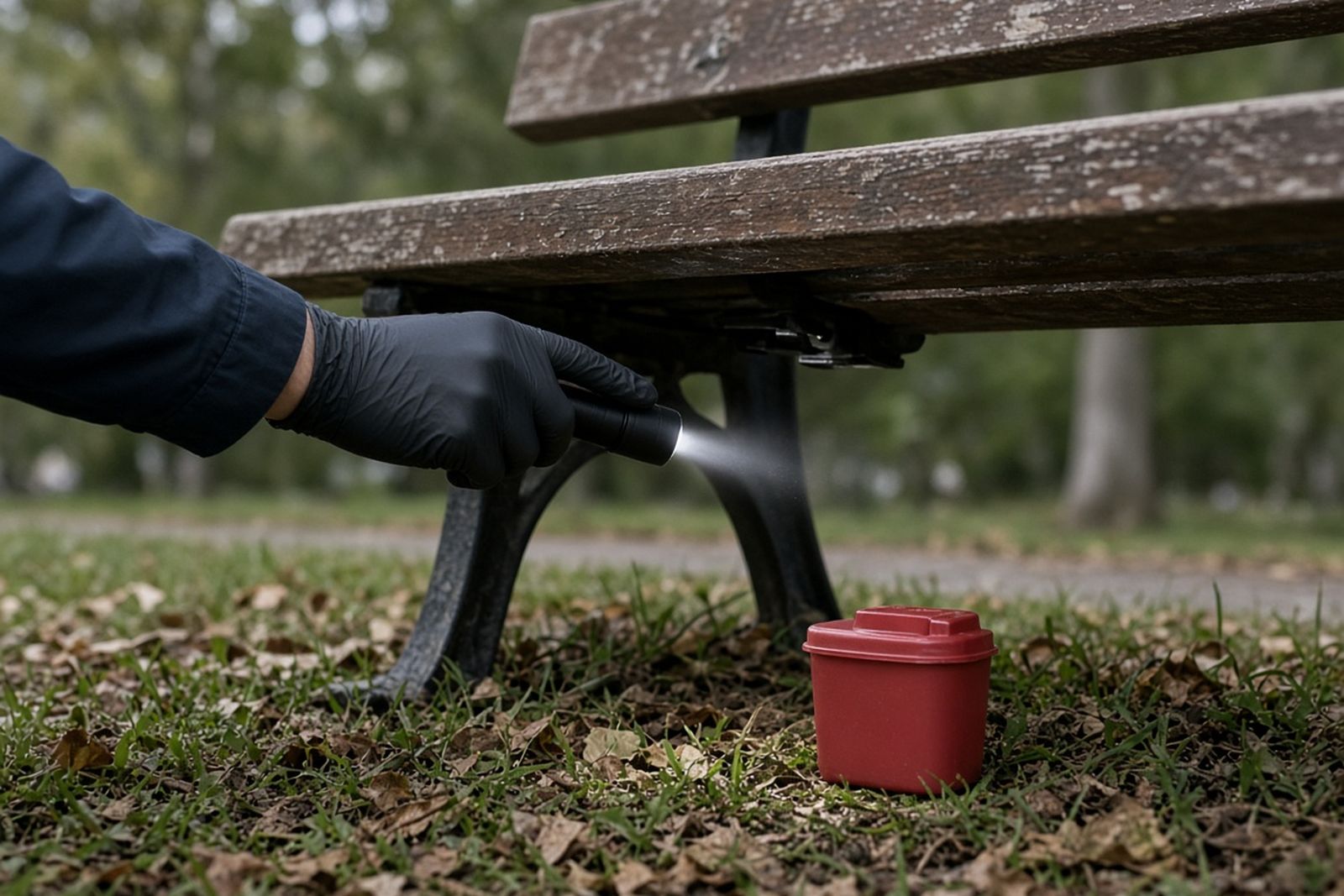
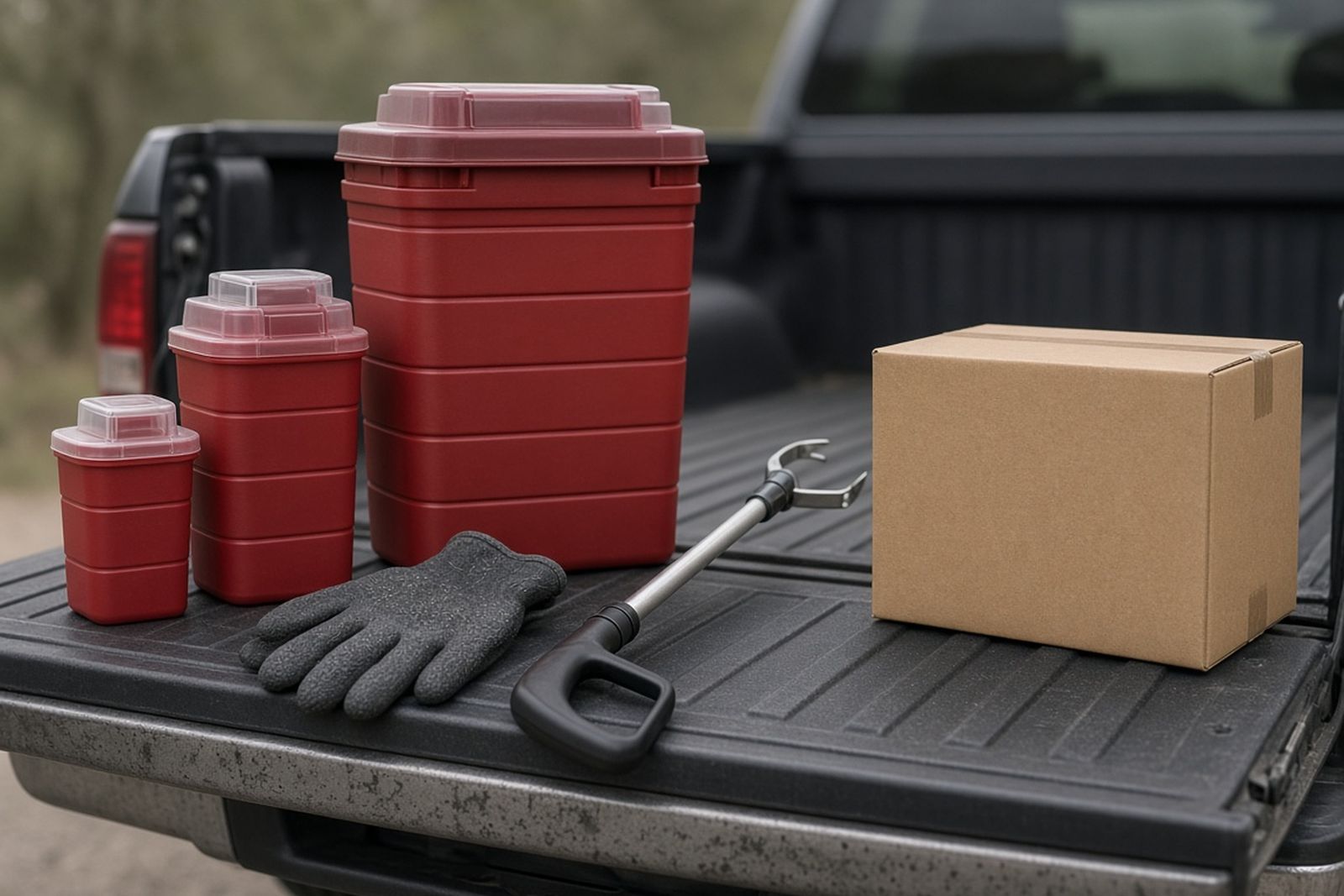
Ask what your technicians pick sharps up with and where they put them. Listen for no-touch tools, such as tongs or grabbers, and rigid, puncture-resistant sharps containers that close securely, resist leaks, carry a biohazard label, and are swapped out before they overfill.
If a company says technicians pick up needles with gloved hands, or that they put them in a sturdy trash bag, keep looking.
It is also worth asking how the crew handles a needle stuck in something, such as a tree trunk, a crack in pavement, a mattress, or a sofa cushion. Pulling a wedged needle is when sticks often happen. A careful technician will describe stabilizing the object, using pliers or forceps, and keeping hands well away from the path of the needle.
Question 3: Training and protection for the crew
Ask whether technicians have bloodborne pathogen training and how often it is refreshed. Ask what protective equipment they wear, which should include puncture-resistant gloves and appropriate clothing for the setting. For sites with blood, human waste, or other bodily fluids, eye protection and additional barriers may be appropriate.
It is also fair to ask whether the company offers hepatitis B vaccination to its employees and has a written plan for what happens if a technician is stuck. A company that takes worker safety seriously is more likely to take your site seriously too.
Ask whether the company carries liability insurance and workers' compensation coverage. You are inviting people to handle a hazard on your property, and you want to know they are covered if something goes wrong.
Question 4: Where do the sealed containers go?
The answer should be a facility licensed to treat or dispose of medical waste, either directly or through a licensed hauler. Sharps should never end up in regular trash or recycling. Improper disposal does not remove the hazard; it moves it onto the sanitation and recycling workers who sort what comes out of dumpsters and bins.
Question 5: Records after each visit
Ask what documentation you will receive. Look for the date, time, and location of pickup, the number of sharps or containers collected, and confirmation of disposal. For businesses and property managers, these records show that you responded promptly and responsibly.
For homeowners, a record may seem like overkill for a single pickup. It is still worth asking for. If a neighbor raises concerns, if a child reports finding something similar later, or if the city asks about repeat problems in the area, a dated note from a professional provider answers questions quickly.
- Date, time, and location of each pickup.
- Count of sharps or containers collected.
- Technician names or crew identification.
- Disposal facility or method.
- Photos, if you request them.
Questions 6 and 7: Pricing and response
Question 6: How do you price one-time pickups versus recurring service? A one-time visit is often priced with a minimum charge plus time, while recurring sweeps may be priced per visit or per month. Ask for a written estimate that spells out travel, labor, containers, disposal, and any after-hours rates.
Question 7: How quickly can you respond, and what does that depend on? Be cautious of any company that promises a specific arrival time without asking where you are or what you found. A trustworthy answer explains current availability, travel distance, and whether same-day service carries a different rate. For recurring clients, ask whether on-call visits between scheduled sweeps are included.
Ask about contract terms as well. A recurring agreement should say how either side can end it, whether prices can change mid-term, and what happens if the provider misses a scheduled visit. Month-to-month terms give you flexibility while you judge the quality of the service.
Questions 8 and 9: Debris, and what happens after a stick
Question 8 is whether the crew will also remove the debris found with the needles. Needles often come with cookers, caps, wrappers, bloody tissues, and sometimes human waste. Some sharps companies handle all of it; others limit their work to sharps. Know what is included before the crew arrives, so you are not left with a partly cleaned site.
Question 9 asks what you should do if someone is stuck before the crew arrives, and how the company handles it if one of its own technicians is stuck. The provider should tell you plainly that anyone stuck should wash the area with soap and water and seek prompt medical evaluation. For their own crew, they should describe an exposure plan. If you run a business, ask your insurer and your county health department whether a needlestick on your property needs to be reported and to whom.
Question 10: Can you help us reduce repeat finds?
For properties with recurring finds, the best providers do more than pick up. They notice patterns: which corners collect needles, what time of week they appear, and what features of the site make it attractive for use or discarding. They may suggest better lighting, trimming dense shrubs, replacing deep mulch, securing stairwells, or asking the city about a public disposal box nearby.
You do not have to act on every suggestion, but a company willing to give this kind of advice is thinking about your site as a whole rather than as a string of billable visits.
If you are a landlord or business owner, ask whether the provider can brief your staff or tenants on what to do when they find a needle. A five-minute talk from someone who handles sharps every day often does more to prevent injuries than a printed policy nobody reads.
Worked example: a church parking lot
The church below is an illustrative composite, not a client story. A small church notices syringes in its parking lot and around the back entrance several mornings a month. Volunteers have been picking them up with garden gloves and dropping them into a coffee can. The board decides to hire a professional service.
The board calls three companies. The first offers a low monthly price but cannot say where the sharps will be taken. The second offers weekly sweeps with sealed containers, disposal records, and on-call visits, and suggests adding motion lighting by the back door. The third handles only emergency calls.
The board chooses the second company, retires the coffee can, and posts a simple rule for volunteers: do not touch, mark the spot, and call the provider. Within a few months, the sweep logs show that most needles are found near one poorly lit corner, which gives the church a clear place to focus.
Answers that should send you elsewhere
Some responses are clear signs that a company is not equipped for sharps work. If you hear any of these, it is worth making another call.
- Needles collected by hand, even gloved, or dropped into trash bags.
- No answer about where the sharps will be disposed of.
- No written estimate or record of the visit.
- A guaranteed arrival time given before any questions are asked.
- No exposure plan for technicians who are stuck.
- Dismissive comments about the people who left the needles behind.